Wednesday, January 17, 2007

Artist and Craftsman

Today I was privy to a wonderful discussion. It is amazing that the human soul is always viewed through the keyhole of the human body. We think that the various facets of a person are united in the body that seems to contain them all. And this was the thought that passed my mind while I overheard the discussion on a table behind where I was sitting at the Murugan Idli House. They have partitions between tables to discourage nosy people (ahem!) from intruding in the little private spaces awarded by restaurant tables. Many places don't even grant you that much; people would quite casually join at your table if a particular corner is not covered by human hand, coffee stain or a plate of idli/dosa.
What made the discussion wonderful? The discussion relayed my thoughts as if I was the third person in the conversation. I would have thought of something and one of them spoke it as if I had handed him a chit of paper and whispered "Psst!". It happened several times and often I felt that one of them was presenting my thoughts better than I could ever do.
Let me hand over the stage to them. I don't recollect the earlier bits of the conversation, so what follows is from where I remember. My thoughts inserted in curly brackets.

"... and he said that he would put up a post related to that comment", said deep voice (DV)
"I doubt whether he would. He is an artist so you can't predict what he'll write", said mellow voice (MV).
"I don't think he is an artist. He keeps talking about reworking and stuff and he writes these things called experience writing - a term, he says, he coined - which seem to be based on events that might or might not have happened with characters who might have been there in his life but are just the physical entity which he fills with the persona he chooses, making them live emotions and events which they might never have, although it would always comes across as plausible."
"But he also writes things in one flow. You remember his posts, right? I spoke to him after reading that koan of his and he goes "I don't have a clue why I wrote that." Now isn't that a mark of an artist?"
{Why is everyone so impressed by suddenness?}
"Why do you think that if a work of art stems from an abstruse afflatus, it is truly art? Can there be no work of art which requires deliberate thought and planning?"
I suppose MV was thinking about this or sipping tea before it grew cold.
"I think we need to distinguish between art and craft, don't you think?" asked MV.
"I am not sure. Take a look at this photograph. Do you think it's beautiful?"
"Of course!"
I was wondering what they were looking at. I contemplated getting up and peering over the partition, but I wasn't sure how they were seated. But what had that picture got to do with this discussion?
"Why are you suddenly showing me this picture?"
"Do you think it is a work of art?"
"Surely. What colour! I love the colour of the sky against the windshield and the bent signpost. Very well captured."
"And what about this picture?"
"Neat. Where did you find this? Since when have you developed an interest for photography?" asked MV.
"Oh! I have always been interested in the arts and I got these pictures from the links on his blog."
"Really? From his blog? How come I missed them?"
"Do you know that the first picture has been touched and modified by Photoshop?"
"Really!? Oh! But then what is the point of that? Anyone can do that. And the 2nd one?"
"Well, its a shot that was captured at that instant."
"Now that is photography!"
{So something untouched is photography?}
"Why? Just because it hasn't been touched?" asked DV.
"Yes, what is the point manipulating something. It is basically rigging it, right?"
"In a way, yes, but photography is always that. With film based cameras, the dark room is where processing would happen and that was never considered artistic enough when compared to still life painting or something like that. Every art form has gone through its stages of being considered ersatz."
"But don't you think that photography is about the eye of the photographer and hence reveals his aesthetic sense?"
"True, but a picture touched in order to reveal what the artist wants is also revelatory of the newly-defined artist's aesthetic sense, isn't it? Now, the artist is not a photographer but a digital image... whatever, but he is also an artist whose tools and building blocks are now different. For a photographer it is the real world, perhaps. For a digital artist it is a snapshot of the real world which he can now work on to create an image which he can see in his mind's eye and which didn't exist in the real world or in the snapshot."
{When does one stop? Everything can be made an art?}
"Then that would require being clear about where one draws a line to one's art form. Photography ends there and digital imagery starts here. Else it would be quite difficult to understand and appreciate art forms", said MV.
"Well, how does it matter where we draw lines? I think that is why he said Does it matter where the river is born when it cannot quench your thirst? in response to one of the earlier comments."
"True. Would it matter whether I really saw a man writh in pain after being bit by a snake, or is it sufficient that I can make the reader "see" the man writhing in pain? Let's hope he writes about it as he promised."
"And then there is this infatuation that patrons have with art produced by the mentally affected or drug-induced art. I don't..."
"But there is an other worldly thing about those products. Something that leaves the source unknown and unreachable. Isn't it a wonder how they create such brilliant pieces! Listen to Miles Davis, Ray Charles, read Woolf, Poe, Kerouac, admire Van Gogh, Michelangelo... you name it. There are more whacky people admired than pedestrian artists."
"I agree, that there is this aura about them, about their muse and where they derive their inspiration from. But is that how art should be defined?"
{No! But there is some magical quality to the thing that springs from unknown wells.}
"I agree that art is not defined thus, but mystery when combined with art has its own value. People aren't merely interested in the art pieces. They want to know more about the artist, where he comes from, what stokes his creative fires... and when they find a puzzle in the artist, they are attracted more towards the art pieces he produces."
"But that is not what should affect our judgement, right?"
"Absolutely not but that brings us back to the distinction between an artist and a craftsman."
"I hesitate to realise the difference."
"Come on, it can't be that bad. I think an artist is one who gets a clear vision and acts on it. A craftsman would be someone who uses effort and intelligence to create something beautiful. An artist would be purer in a sense than a craftsman."
{How untrue!}
"See? This is why I hesitate. I think they are both pure. What if the artist is a sculptor? His vision might take a few weeks to take form, right? He would employ effort and intelligence, right? So would you call Michelangelo an artist or a craftsman after he completed the Pieta?"
"Aaah! the Pieta! She is so beautiful. Yes, I agree with you. It does become difficult. But photograph manipulation has to be a craft and not an art."
"I disagree. What if the photographer saw the scene before his eyes and was able to picture how he would want to render it eventually through digital manipulation? Every photographer who can adjust aperture and exposure in an SLR is manipulating the image already, isn't he?"
"It does appear like it is a very thin line. So what is the mark of an artist? How is he different from a craftsman? Is there a difference at all?"
"I don't know. It is easy to say no but I am sure he might raise some interesting points in his post."
"If he writes", said MV.
"Yes, if he writes. You can't be sure about his writing though. Sometimes it seems like craft and sometimes like something readymade which he just put up on his blog."
"Yes. Actually he is a decent case in point for the thin line vanishing."
"Or like Forrester says in "Finding Forrester": You write your first draft ... with your heart. You rewrite with your head."
"I think he said that too over the phone, a while ago. He might have seen the movie."
"Probably."
{That quote tickles something in me. Maybe that is the clue that he gave to MV.}
"Is it possible that that is what he means to be the distinguishing factor between an artist and a craftsman?"
"What do you mean?" asked DV.
"Think about it. Think about what he said about the river being born and thirst quenching. I think he means something in that."
"Hmmm. I think that is part of the answer. His response to the other part is hidden in his many koans. The point is that every reading gives me a different meaning."
"For all you know, he might be clear and blunt in addressing this issue. Let's just wait for his post. "
"Let's."
I was happy that my breakfast was peppered with this conversation which made me smile... though I wonder who they were talking about.

Thursday, January 11, 2007

Beautiful Stance

One truth, several renditions... Photo: Courtesy The Hindu Photo Library


This picture (this is the best size I could find. Please obtain a copy of the Magazine for a better copy) was part of an article (in The Hindu Magazine) about the late danseuse Chandralekha. I admired her though I had seen very little of her work but this picture held my attention for a long time. Look at the 3rd lady from the right. Her form, to me, is perfect. Very good ara-mandi (half-seated stance). Look at the sharpness of her Hamsasya mudra, the curve of her spine. Notice that she doesn't lean forward or backward, but uses the suppleness of her spine to hold herself erect though in a smooth curve. Notice her feet on the ground - nearly perpendicular to each other. Her shin doesn't lean to the sides. Notice how her right wrist is held firmly in place although she looks at her other hand. Her abdomen is tucked in just right and notice the sinuous belt that she wears - goes perfectly well with the curves of her body. Her belly is sensuously visible over the belt (although not clear in this picture) and she holds herself without leaning forward or pushing her rear out back too much. Her neck is not too bent nor does it lean to the sides... I wonder who she is. So delicate and yet so powerful. I suppose the lady is well into her 70s (if she is still alive). Try blurring your eyes while seeing this picture and you will notice the flaws in the other postures and the correctness in hers. If anyone has any clue about her, please let me know. I would love to meet her. I salute her for managing a near perfect posture. Lord Nataraja would have been terribly pleased with her.

A case for astrology

A long long while ago, two men were sitting under a tree. One of them said, "I must go to Nalanda to visit my son." (yes, that long ago). The other looked at the firmament through narrowed eyes and said, "Three stripes of red and blue; travels should be few." The traveler shook his head and said, "No travel is all cool winds and warm sunshine."

In spite of people as mature as our traveler, the meteorological department came into prominence, although not many trust it. I remember watching a movie starring Rajesh Khanna (RK) and someone whose name I don't recall. The heroine's father was a great astrologer and RK was a non-believer. Once RK goes to meet his lover and overhears her father telling someone, "Don't do ----- as it will rain today at 5:00 p.m." A conversation follows between RK and his love about the foolishness of these practices and it starts raining. Time: 5:00 p.m.

Astrology and/or other forms of divination exist in each and every culture and society. Wonder why? I think there are two things that one must notice. One, astrology is not a need based practice (I will not call it a science). Two, human beings will always be anxious/concerned/frightened of what lies in store for them in the coming days. This anxiety creates a need in each soul to fortify their future in the best way possible. As they take care of the financial and corporeal insurance, information about the future is also considered vital and is hence, sought out. Some of this information is in the form of concrete plans and the rest is known as speculation. Speculation about financial trends, technological trends, political trends are all considered the best butter at your breakfast table or the finest cigar in the smoke room. But astrology is always considered a sissy matter. I wonder why.

Let me present what I have gotten to know/learn about astrology over several years before I gave it all up (not because my belief in astrology waned).

Astrology is a fine art of predicting about the future based on the movement of planets relative to their positions as it was at the commencement of an activity (e.g. planets at the time of the birth of a person, at the start of a business, at the time when a country gained independence). Astrology branches into a few streams; natal, horary, muhurtha or electional. They serve different purposes and are employed at different times. Prasna, as widely practised in Kerala, is a form of horary astrology.

Planetary positions were quite accurately determined by our ancestors (SuryaSiddhantha is a wonderful reference for that). They didn't possess telescopes or other finely graded instruments. Yet, they could accurately determine the number of planets as well as their details like orbits, velocity (real and relative) and positions in the zodiac. The Indian system of astrology has been sidereal (Nirayana) unlike the western system. I shall restrict this presentation to the Nirayana system (because it makes a lot more sense to me).

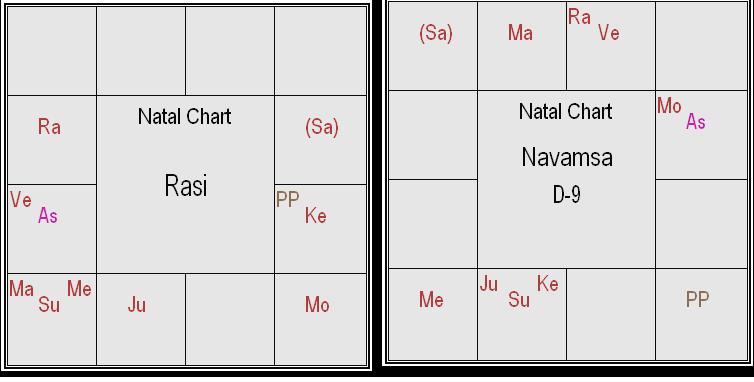
So, person A is born. At that very instance, the planets occupy specific positions in space. A snapshot of the heavens is cast as this boy's horoscope. The horoscope is not just one chart consisting of 12 houses/rasi. There are divisional charts which are constructed from the main chart and based on rules. Each such divisional chart is consulted for fine tuning predictions pertaining to specific issues (like the navamsa for dharma kaarya including marriages) but the main chart is vital (as it is the real position of the planets while the rest are derived charts). Here is a sample of a chart as cast at this very minute.

Rasi and navamsa
[Legend: As=Ascendant/Lagna, planets within () are retrograde. Interesting thing to note is the position of the planets when this post was being composed. Totally unplanned.]

Based on several rules, aspects, relationships between planets, ruling periods (or dashas) and various other parameters, an able astrologer will make predictions.

Here arise several issues. The typical complaints against astrology have fallen into the following brackets:

1. Predictions don't always fructify
2. What is the scientific basis for this? How can planets affect us?
3. If this is the prediction then how can gems and mantras alter the course?

This is how we need to understand the ways of astrology and an astrologer. An astrologer is an interpreter. His input is not clear-cut sentences but patterns and cryptic hints and clues. An astrologer is ruled by his horoscope as well. An able astrologer would do one of the following:

1. Mark times in his life when he would not have his tongue aligned with the ways of the Divine and avoid consulting at those times. It is vital that he does this during the good phases of his life!
2. Fortify himself by performing austere penance as specified in the shastras.

Both approaches have their issues (a wonderful case in point is the story of Thalakulathur Bhattathiri of Kerala) and as every astrologer knows, nothing can be placed as final.

Allow me to present my understanding of this subject and why I find the treatment meted out to astrology as unfair. I shall consider one bracket at a time.


1. Predictions don't always fructify

What astrology provides is a probability graph of incidents in the life of the native. Astrology never claims that it is the final word. A popular verse in reference to astrology is:

Phalaani grahachaaren soochayinthi maneeshinaha
Ko vaktha tharathamasya tham ekam vedasam vina.

which means, the results of planetary transits can be inferred by human beings, but who can speak of them with certainty other than the Lord Brahma (Vedasam).
This is not a caveat/disclaimer but the truth and the humility with which astrologers approach their practice.
So this point is vital to understand. It is nothing more than a probability matrix/graph.

Consider popular scientific fields in vogue. Nearly all of them rely to some extent on prediction and predictability. Half-life, weather forecasts, DNA mapping to diseases, stock markets, tectonic movements, chemotherapy (they give you a probability of the effectiveness), etc. all hinge on the predictability inherent in their fields. None of these have ever been condemned in public and failure abounds in these fields. Cholesterol levels have been a popular indicator for cardiac ailments. A village in Italy (or southern Europe) houses people with cholesterol levels more than 4 times the safe limit and they have not had any cardiac problems (major pharma companies are working with the residents in identifying the diet patterns and how to capitalise on this! They spotted something in the fish they eat). I needn't enumerate instances when scientific methods have also gone kaput with their theories and predictions (look at the whole set of assumptions and discussions surrounding the Big Bang theory). Any prediction is bound to be subject to parameters. In an F1 rally, if there was only one car driving around, we might all be certain that it would be the winner, but that is assuming that it doesn't blow up as soon as it shoots off the start line. Think about it, predictions cannot be 100% certain and allowing astrology that, is not doing it a favour. Next time, try asking your homoeopathy (or any -pathy) doctor to give it to you in writing that the tablets/pills they prescribe will certainly cure you of your ailment.

A vital point is the need to distinguish between astrology and astrologers. An astrologer can be bad (like the many hundreds I have known) but astrology need not be at fault. That is why I like the concept of the AshtaMangalaDevaPrasna; several astrologers get together to divine about the query thereby eliminating chances of someone missing a vital omen or pattern. A few astrologers had once tried this out while analysing a particular chart (of a peon who was having some problems). I enjoyed that experience and noted how so many things came out of it which each one of us one our own might have missed. Hence, astrology and an astrologer are not alike as much as medicine and a doctor/quack aren't. How many people stop considering diets although thousands of reports come out about the inefficacy of those practices?


2. Scientific Basis

This is the most common one and especially amongst the younger generation (boy! I feel old after having said that!!). I find it stupid that we seek scientific basis for everything. The world is not science stretched between the North and South poles. Life is not science. Science has its purpose and should be restricted to that. Belief systems and non-scientific practices will be that. If you don't wish to follow them, don't. Don't demand a scientific explanation for that (as much as you wouldn't demand a scientific explanation for why your boyfriend dumped you). What is the scientific explanation for your broker's advice on what scrips to buy? Why do all the scientific explanations for the weather forecast reports go for a toss and then excused in the "light of recent developments off the coast of Bay of Bengal"?
If you are interested in scientific explanations, have you ever bothered to investigate on those lines? Several centuries ago, people laughed at the spherical earth theory until someone proved it. Science still cannot explain a million things on earth ("How do placeboes work?"). Complicated principles and theories are formulated for things that were always difficult to explain (good ol' Heisenberg). Has anyone seen an electron? Or a photon? But don't we already believe in them and in the infinite theories hinging on them? Nuclear physics abounds in examples which defy a "scientific explanation". Has anyone measured 0? What about complex numbers and the square root of -1 which is undefined? Why do we accept these? Because they come in text books and find patrons amongst the people we admire/respect/fear?
So let's find a scientific basis for astrology. Are you willing to conduct experiments with Jupiter's exaltation in a person's chart? What about the analysis of the Kala Sarpa Yoga/Dosha? If you aren't willing as you are unwilling to experiment with photosynthesis or zygotes, then let's denounce all things unexperimented (including the internal combustion engine and hence all your vehicular transport systems) and accept and adopt only those things that have a scientific explanation that you have personally verified. Game for this?
Does this mean that we blindly accept anything argued on these grounds? Well, you decide. I believe in a simple rule: If it works for you, that's your elixir.
I have known several people who have benefited from an astrological advice and I think if something has helped even 10% of the world, then it is worth a shot. Has it caused wars, death, disease or turmoil in 10% of the world? If it hasn't, then it is worth a shot. "Scientific basis" is a silly argument if you aren't willing to investigate. Where will you search for a scientific explanation when doctors unhesitatingly advice the patient's family to TIG; trust in god.
With scientists condemning astrology I would like to open a challenge to any scientist and/or body of scientists to come up with their own methodology to predict the future. Till they succeed, I think they would do well not to condemn something they haven't even studied.


3. Altering predictions

Personally I have never done this. I have offered mantras for ensuring peace of mind through a phase of turmoil but never to undo something. I don't think able astrologers do that. Quacks might. There is a course of action that can be advised like a diet plan or a strategic plan. This course might include gems and mantras to the presiding deity. A close relative of mine wasn't able to conceive and she had approached me (although I had given up astrology by then). I knew her chart by heart and hence couldn't help helping her. Mars was affecting her 5th house (progeny) and I had advised her a course of action which involved prayer as well as wearing a coral. Had Mars or any other planet been positioned to deny her a child, then the approach would have been otherwise. Well within the specified time of the penance (and not all penances are done under the Bodhi tree or in forests!!) she conceived. Would I attribute it to the gem? Nope. Would I attribute it to the mantra? Nope. It was the right course of action. Another story attributed to Thalakulathur Bhattathiri of Kerala is the one in which he countered the prediction made by his son regarding the sex of a child (of the native who had consulted the son). Thalakulathur Bhattathiri realised that his son had been hasty in predicting the sex within the first 3 months of conception and treated the lady with Ayurvedic medicines (oh! btw, an astrologer is supposed to be learned in a million things. There is a strict code of conduct specified in the shastras. By those standards, there is no living astrologer on earth today, to the best of my knowledge.) and the sex of the child was altered. I though this was a good fable until I read medical journals where it is said that sex organs do start forming around the 12th week and sex determination can be reliably done around the 16th-20th week. Well, how on earth did the astrologers of the then era know without scientific basis!?


Closing Notes

1. Anything done in order to cheat someone or take unethical advantage of someone's weakness is unacceptable and is open to critical action (at times legal). So be it with astrology. But there are honest and well meaning practitioners and hence, astrology and astrologers cannot be covered by a single blanket.
2. If it suits you and has worked for you, feel free to consult an astrologer. If it hasn't worked for you, then avoid it but there is no point in condemning others.
3. Without studying astrology condemning it is foolish.
4. The way of the Divine is over and above all this and astrology and the Gods are but means to realise the way of the Divine. If you are spiritually clear and are focused on the Divine, then astrology or any divination technique has no relevance to you. But being half-baked is never palatable.

Tuesday, January 09, 2007

Nadia

Nadia
An unrealised romance is always more charming and tantalising, for the possibilities, in this case, are infinite.
Her name was Nadia and I never knew till then that it was also the name of the smile that stealthily crept on my lips every time I saw her. Her very presence softened me, tempered my exterior, while every inch of me throbbed with the pleasure in that togetherness. She was perfect in every way (and to a student that I was then, she impressed me with her scores in school, too). Nadia, dear Nadia.
She was all of 11 or 12 years old then; I, 15. We were vacationing in Yercaud in the Sterling Resorts (which seems to have vanished now) when she and her family arrived. She was the oldest of the children in her family. There was Nadia, Mona and their younger sister whose name misses me in the flooding memory of her elder sister. They also had a younger brother who was mostly found clinging to his mother. Mona loved to talk and was the most boisterous. She cracked all kinds of jokes and we had a ball of a time playing games. But Nadia had to simply walk in and nothing else mattered to me. Mona would get irritated with my distraction but I couldn't help it.
Nadia dressed in beautiful clothes, like the black lycra pants and magenta pullover, which she wore on the trek that was organised by the resort. I am glad that we walked through the toughest paths, for it presented several opportunities when Nadia would look up to me for help. Her hands were soft in mine, like white cotton-wool, and she let them stay in mine well after the help sought.
We became good friends and spent several games of Uno, carrom and table-tennis into bonding stronger. We read Archies and other books that the resort had but preferred spending a lot more time simply walking around, with Mona or my sister as avoidable company.
Nadia. Jet-black hair framed her ivory face in straight lines. She would often wear her hair in a pony-tail or occasionally (and once at my request) leave it unrestrained. Her eyes were deep and would peer deep into you. I liked her for her silence and how her little laugh was clear as it stood out even in the party din. Her lips would smile just at the right time and just to the right extent. She wasn't given to excesses, although she left me with an excess of yearning for her.
I would be the first to rise (which had less to do with her than I now imagine) and rush into the resort common area so that I could get the most of her. While in the van transporting us on site-seeing tours, I inched my way next to her. I hated it when another friend's father was speaking to her and hence, didn't like that friend too. Nadia made me what I never was with anyone else.
It's more than 12 years since this happened. Today doesn't feed me a different emotion than what it did then on the hills of Yercaud when someone called out: "Nadia". I remember rushing to wave out to her as her family left for another segment of their vacation. She told me that she was from Hyderabad and was going to Madras to visit her cousins (I reeled out all the Muslim friends I knew in Madras but none of them turned out to be her cousin). I vaguely recall a surname that ended in a "waala".

I'd like to imagine that she liked me. Still does.
I'd like to imagine that she still thinks of the days in Yercaud.
I'd like to imagine that she is still single on a solitary hope.
I'd like to imagine that she smiles when someone across the road calls out my name.
I'd like to imagine that when we meet, she would swallow her tears and hug me.
I'd like to imagine her looking out of the van when she visits Yercaud again.
I'd like to imagine that someone points this post to her and asks: "This is you?"
I'd like to imagine her shake her head but be unable to take her eyes off this post.
I'd like to imagine that she would drop a comment here....

As I said, that which holds the potential of being love is sweeter than that which is.

Monday, January 08, 2007

Dance of Light

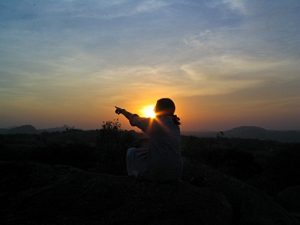
The way of all light


Isn't the way of light filled with shadows too?

Margazhi/yyi

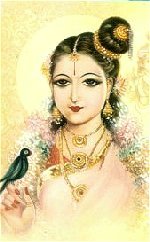
Dear Andal, isn't Spring lovely Kannan's Lover
Amidst many hued flowers and birds' anthem?
'Tis dull compared to Margazhi
When my Kannan's music throbs down my bosom.

Margazhi (and I shall resort to this spelling although I am averse to the Tamil "y" written in English as "zh". So this is how it goes: Say Maarg-uh and then stick the tip of your tongue to the roof of your mouth and say yee. Don't stick your tongue throughout the recital.) is beautiful; beautiful in what it presents as well as in what it promises. Margazhi, for long, is associated with music festivals and the SriVaishnava sampradhayas. Margazhi rings in the days when my mother wakes up early, well before sunrise, and donning a "madee" saree would proceed to the prayer room cum kitchen in our quaint flat in Bombay. I was always "madee" (and I later learnt that that was a convenient concession granted to me since there was no other way for her to manage me when I could still crawl under chairs and climb on top of shelves) and loved to watch her prepare the pongal (mom calls it thirupakshi and I thought that meant holy bird, but as nearly always, I am well mistaken). Pongal is one dish which is easy to prepare but which requires a loving mother to make it tasty and memorable. I preferred my "holy bird" hot, with a lot of cashews, softened black peppers, jeera, just the right tinge of yellow (due to the moong dal. I hate calling it paasi paruppu) and lots and lots of ghee (clarified butter). Ummmmm. Give me those days, throughout the year.

Mom would split the prepared "holy bird" into two portions; one without salt for the gods and her son (now I know why she called me Kanna and even named me Uppili adding to my collection of several names that were showered on me when all I wanted to do was lie on my back and be cleaned occasionally) and another, with salt for the mere mortals of the family!

She would make a variety of chutneys to go with this "holy bird". Chutneys made purely with grated coconut, coriander, curry leaves, combinations, tomatoes, ginger, combos, green chilly, gooseberry (nellikai) (join me in the mouth watering ceremony; I while I write and you while you read) and sometimes with cucumber. No wonder the ladies of the world think that the "holy bird" would successfully seduce the One-whose-skin-is-of-the-hue-of-dark-blue-clouds. Lesser wonder that Oothukaadu Venkatasubbaiyyer (don't sue me for the spelling) sang to Yashoda "Undhan paiyanai polave indha, vaiygathill oru pillai, ammamma naan kandathillai". Indeed, the butter-stealing darling of Yashoda deserves nothing less than this treat (though we both prefer it with fresh white butter with a few sugar crystals dropped in).

Everyday, mom would sing a different paasuram, which was more often than not, off-key (or so I thought). But I loved her voice bouncing off the bulb-lit walls of the kitchen, making the golden flames bounce in their silver receptacle casting shadows of the gods that danced within their well painted frames. I would love to watch the fiery tips of the wick cast a reflection on the yellowish oil in the freshly cleaned lamps. It wasn't my imagination but the golden blades of fire did dance to the tunes my mom laid out for them, while the rest of the world continued to sleep. Mom would coax me to go back to sleep, but was glad that I didn't listen to her. She saw in that obstinate act a promise of at least someone in the family carrying on the tradition of waking up early to cater to the gods. Such was the simplicity that made her smile and coo, "Enn Raju!" (My little prince!). If there is something that I can explain to anyone on earth, it is what drove Krishna to be more and more naughty. If I have become thus thanks to the love of one woman, think about what fired him to be the brat of an entire village.

Several years later, we came to Madras (you call it Chennai, I'll call it Madras) and I realised that had there been Indian Airlines (or Jet) back then, then Krishna would have moved out of there to here (to hell with a bunch of squabbling cousins!).

Margazhi in Madras is announced.
Margazhi in Madras is cherished.
Margazhi in Madras is relished.
Margazhi in Madras is beautiful.

As the lights of the sodium-vapour streetlamps streamed down, tangoing with the rising smoke from the stoves preparing pongal, I watched ladies, fresh from a bath, stooped over the patch of land right outside their door. Lovely white powder streamed from their fingers as they teased the earth into revealing brilliant designs. They'd stop to wipe their forehead or brush an eager strand of hair - eager to watch what colours the earth - back and the fluency of their movements made them gorgeous in the dimly lit passages that led to the temple towers of Mylapore. They would softly hum a song to the Lord while managing the curves of the kolam and the level of the milk in the pot, not far away.

I could stand there all morning, watching these women blossom into something lovelier than what womanhood could ever promise. And the world around them blossomed as the Vishnu Sahasranamam rumbled from the Srinivasa Perumaal temple, bringing with it the fragrance of flowers and sunrise.

The crescendo to this flowering beauty which snaked down the narrow streets of Mylapore, nudging smiles of contentment on the faces that lined the grilled windows, was the sudden flutter of untainted mirth wrapped in shrill giggles and silk. Out poured a bevy of doe-eyed beauties sparing no threshold of their soft feet and no heart of the love they commanded. What happens to them after they grow up, is beyond me!! Though I pouted at the fact that my sister got more clothes during festivals, I was happy for the very same reasons; many of her friends would visit us in their sparkling new clothes. Well, you lose some, you get some. Jasmines and December poo (flowers that bloom in December) on black locks falling oh-so-lightly on a red silk blouse atop a butter-white paavaadai (skirt) with gold butta (small gaping polka dots with a design)... I shall stop here with a call to retaining my sanity.

One could walk down narrow alleys with temples and houses decorated well. I saw a temple with a "To Let" board once and wondered whether the Gods would show the prospective buyer around the place ("There is where the missus and I go to rest and that is the well from which the priest gets us cold water to bathe. Yes, even during the months of Margazhi"). One could stand near the dwara (entrance) of a temple (and without offending anyone, a Vaishnava temple would be more rewarding in these months) and close their eyes. The conversations about kutcheris (concerts), how the new daughter-in-law couldn't even make gotsu (an eggplant sauce served with pongal), how that singer insisted on down-payment before the concert, about the new show on Jaya TV where they will be showing all the DivyaKshetrams... and you'll smile too. Temples in South India incur conversations about anything except the Gods. Maybe the Gods seek such gossip too!!

And as I listen to the waning chatter about the rising prices of moong dal and how 200 gms of ginger is now Rs. 10 when just a few months ago it was 2, I watch a young man with the skin like ebony, made darker in contrast with the glaring white veshti and shirt, cycle his way through the crowd that hums around the temple. Like a promising spot on the back of his shirt and veshti is his tiny daughter, dressed in bright green, wearing a pinch of the December poo, and clinging to the loose end of her fathers shirt (how could he leave her to sit on that hard metal carrier?). Her constant fear of letting go of her father is now replaced by the awe she feels in the midst of this human field of devotees thronging a god whom her parents worship and who gives her sweet water to sip and tangy green leaves to eat. She watches them flow in and out bathed in the tunes of a far away naadhaswaram and dodging the vegetable vendors and flower sellers as they rush to see their god, their Kannan who might just grace them with an iota of his love that he showered on Andal. As she continues to clutch her father's shirt, she smiles at what she will one day recollect... with a smile.

Friday, January 05, 2007

Mass Belief Systems

Or in other words, religions and cults, are one of the most interesting organic entities that man has ever created. It amazes me to find people adhere, switch, juggle and denounce these MBSs with unabated conviction and zeal. I remember once mentioning this to a friend, "Anything which requires me to first believe in it before understanding it or realising it, is surely not the Truth."

I was exposed to Jiddu Krishnamurthy at the age of 18 (you decide whether that is young or not). An uncle of mine read some of my essays (unpublished) and thought I was inspired by JK. Unfortunately, I hadn't read JK till then and had only heard about him (spoken in hushed tones at home, because mom didn't quite like him though dad, who in a way resembles JK, used to attend his discussions). Fortunately, the first piece of JK's thought that I read was this: Truth is a Pathless Land. I clearly remember jumping out of my chair and exclaiming: "Jolly good, this man makes sense!" I have read him only sporadically after that, just to pass my time.

Why I recount this incident is to clarify what many people think: Eroteme is a follower/believer of JK (though you would believe in and not of). I am still to figure what I believe in. Even Taoism is something I realise and not believe in per se. Nevertheless, it would be safer to say that I am a non-believer or a pan-believer than anything else.

What amazes me (and I wrote a piece of fiction in Alvibest about this) is the cult movements that attract so many people from all over the world. Be it Osho, Sri Sri Ravishanker (SSRS) or Satya Sai Baba, they all seem to be doing or saying the same stuff which was told and done for centuries. For centuries, India has been the fertile bed of several schools of philosophy and religion. This is the land which also created the Samkhya Philosophy as well as the Bhakthi movement. But there never was a cult for Yajnavalkya, for instance. So why do re-hashes and packaging get so much attention?

Today, I read about SSRS on Atanu Dey's blog. I enjoy what he writes though, often, I take it with a pinch of salt (well, he is a passionate man) but his series on SSRS is very accurate and fair. It was quite hilarious reading, though the humour was more thanks to SSRS's devotees than any other reason. Coincidentally, I also read Steven Hayes' theory on happiness and a dear friend was clear in her observation: this is for crazy people who can't understand themselves. I will explain later why Steven and SSRS are mentioned in the same paragraph.

I think the cults are for the mentally and psychologically incomplete individuals. It is surely not for those who are serious about life and Truth. Had they been serious, they would have stuck to their search of Truth and not stuck to an individual. An individual can never be Truth. He might have an idea of Truth, but he will never be Truth. As the great Lao Tzu said, those who know, speak not (verse 56). Then what about JK or Buddha, you ask. I don't really care. Whatever they may have been, they were more interested in Truth and life and went into that question deeply without prescribing techniques and gimmicks. Hence, I respect them although I do not agree with them on many counts.
Only those who are dissatisfied seem to go in search of cults. have you heard about any person who was so happy with his job, family, friends, hobbies, financial situation, health but still went out in search for a cult to add to his happiness? Cults prey on those who aren't clear about themselves or life. Cults are like shots and provide nothing more than a feel-good dose. One more thing about these cults that makes me roll my eyes is this name changing business. Suddenly someone is SarvaSukhaAnanda (I don't know anyone like this and just made it up. Any resemblance to anyone dead or alive is pure coincidence). India has this obsession with Anand, Baba, and Shri (even atma and maharaj). Everyone great must have one of these in his or her name (maa, rani, devi etc. for women). Get real, guys! ISKCON takes the cake for the renaming game.

Cults grate on my nerves because they seem to move away from what they tout. At least Hubbard was honest enough to say: "the way to become a millionaire is to create a religion". And he did.
How can the multitude bring peace to an individual?
How can chanting whatever bring peace to all those who chant?
How can you charge something (money, favours, what you will) when you claim that this is Truth or God's word?

As Atanu correctly points out, people aren't really interested in the effort that goes into spiritual awakening. As I have always believed (and am certain of it), each person has to individually work towards his nirvana. There is no way someone else is going to take you there while you watch Sex and the City. Why should someone do that? What makes you deserve that? While reading or listening to people might help one in one's own journey (which need not be entirely intellectual or scientific), modifying the journey to now become centred around this particular gentleman is quite ... well, off the mark.

My question to cults has typically been this: If your wo/man (the person you worship) dies, then will the great spiritual bliss and blah all die out? If it will then you should realise that this is no longer the Truth. If it won't, then why do you want to stick to her/him and not the Truth? I don't hate/dislike the central person, but one should realise that s/he is not the Divine, not Truth. Why do numbers, marketing plans, stunts, shows and gimmicks rank higher than the Truth?

Get a life. Meditate and if you are meant to attain the Divine, then you will. And what is so great about being philosophical or spiritual or one with the Divine? It only seems to be another point to score on to most people. If it isn't, you wouldn't care about cults. Touche'

Wednesday, January 03, 2007

Ghazals

I still recall the first time I heard a ghazal. It sprang out of an old National Panasonic music system and was carried in the voice of Ghulam Ali. My father had caught me in my moment of tiredness (from running around the house on a walking stick which, to me then, was the finest stallion ever) and asked me to sit on his lap and listen to this new cassette. I remember the black cover with something in blue under the plastic case chequered in clear and misty portions. I was too tired to protest and we sat together on our old sofa (we had two sofas which were conveniently named, old and new sofa). I learnt a lot on the old sofa including the important lesson of a protruding brad's ability to cut your skin! He chose the song "Chupke Chupke raat din" (chupke- furtively, quietly, raat-night, din-day) and let it play softly until it filled the room. I wasn't sure whether it was the heaving of a tired torso or the melody of the song which made the room sway while it played mellifluously with words I never understood and a medley of instruments I couldn't discern. After a while, which is always eternity to a child of five, I jumped out of my father's lap and started riding my black stallion with a mane like the darkest of clouds and eyes like molten nuggets of gold, riding through palatine worlds of evil lords. My father simply shook his head and reclined against the sofa with his eyes half shut.

Another scene that is stuck in my head is a bunch of people sitting around the poet and listening to his ghazal recital. He would say a part of the last line and the rest would join him in completing the verse and then go "Waah, waah" (which is like saying "Wonderful" repeatedly or "Bravo"). I thought they were all cheating us and had read the poem earlier before assembling, a sneak peek; how else could they know what the poet had composed?

Swirling in a whirling universe...
Things have changed immensely since then and ghazals have an appeal too personal to put in words. Often I wonder, whether I would have appreciated ghazals without understanding their construction. I suppose I still admire the stars on a clear night although I have done enough research into their composition and found explanation for the shimmering presence at an hour when one needs light the most!

In this discussion, we shall see what ghazals are and explore a few aspects of ghazal composition that might elicit a greater appreciation hereafter when a ghazal is encountered. Although this might seem like being too specific to Urdu, I would like to bring to notice that the pattern of a ghazal is also used in English, Marathi and Hindi poetry. Translations (sometimes literal and sometimes not) shall accompany the quoted verses.

A ghazal is a collection of shers following a, usually, strict code regarding the style and constraints on the first and following shers. A sher is a couplet. The meter, or beher, of each line in the sher is the same. There are supposedly nineteen different kinds of meters codified as arkaan or syllables used to render the sense of a meter. This technique is used amongst musicians, esp. percussionists, who wish to describe the beat to another person. If we were describing the beat in Hotel California, it might be something like dum-chuck-d-dum-d-dum-chuck or something similar. In order to standardize the mechanism of such communication, meters were specified using arkaan (which literally means pillars). Hence, what we have as a definition for a ghazal is a collection of couplets following a few rules of construction and a single chosen meter. We shall consider the constraints placed on these couplets now.

Let us consider a ghazal to facilitate this discussion and what better than a ghazal from the first album I had heard while sitting on my father's lap and to that memory, I dedicate this article. The translation is not of comparable literary value as the original ghazal, and serves the mere purpose of providing those, who find Urdu an alien tongue, a coarse outline of the poet's creation.

Yeh dil, yeh pagal dil mera, kyun bujh gayaa, aawaragi
Is dasht me ek shehar tha, wo kya hu-aa, aawaaragi


This heart, this foolish heart of mine; why did it die? Loneliness.
In this wilderness, a beautiful city thrived; what happened to it? Loneliness.

Kal shab mujhe, beshakl ki aawaz ne chaunka diya
Maine kaha "tu kaun hai", usne kahaa "aawaaragi"


Last night, a faceless voice caught me by surprise
I asked, "Who are you?" and it said "Loneliness"

Ye dard ki tanhaaiyaan, ye dasht ka veeraan safar
Hum log to ukhta gaye, apni sunaa aawaargi


(In) this pain of solitude and lonely travel through the desert
We soon got bored, So, tell us more about your(self) "loneliness"

Ek ajanabi jhaunke ne jab, puchha mere gam ka sabab
Sehara ki bhigi ret par, maine likhaa "aawaaragi"


A sudden unknown waft asked me about the cause of my sadness
On the wet sands of the desert, I wrote thus: "Loneliness"

Kal raat tanha chaand ko, dekha tha maine khwaab me
'Mohsin' mujhe, raas aayegi, shaayad sadaa aawaaragi


Last night, a lonely moon did I see in my dreams
Oh Mohsin! This suits me fine now and after, this loneliness

This ghazal is a composition by Mohsin Naqvi and hence the last couplet carries his signature which is a very loose traditions followed by poets primarily for the sake of identification (covertly for the sake of immortality!). Let me assure you that the above translation attempts to present only one of the possible interpretations.

The first sher is different from the other shers in that both lines end in the ghazal's special word, "aawaaragi". This word is known as the ghazal's radeef. Every ghazal can have its own radeef and a radeef need not be a singular word. Hence, in a ghazal the first couplet must have both its lines ending in the radeef of the ghazal. This first sher is called a matla. The second line of the remaining couplets must end in the radeef, although their first lines need not. Amongst ghazal lovers a ghazal is remembered usually for its radeef unless the radeef is too common a word or phrase. This ghazal is commonly referred to as "Aawaaragi".

The poet is free to choose any word or phrase to precede the radeef, as long as the last syllable of these words/phrases rhymes. Let us look at our ghazal-in-study: gayaa, hu-aa, kahaa, sunaa, likhaa and sadaa precede the word "aawaaragi" (which is the radeef) across the couplets and hence must rhyme (and they do!).

The beher, or the meter, of all the shers must be the same. Whatever the choice of beher, it must be maintained through the entire ghazal. We shant go into the technicality of which beher family this ghazal belongs to as long as we agree that the ghazal has maintained the beher throughout its length.

A poet usually adopts a pen-name, known as takhallus. Whether he does or not, he would usually mark his composition with the chosen name in the last couplet (known as the maqta). This was and still is a practice adopted by the poet to establish ownership of a ghazal. The name is rarely introduced in a contrived manner but is often observed used in a very clever manner adding a punch to the last couplet. The poet can use his name as if to include himself in the context of the ghazal or have the protagonist in the poem address something to him. It tends to present the poet as a silent observer who was called in only towards the end of the ghazal. Mirza Ghalib, one of the most popular poets in Urdu ghazals, used it with a fine effect:

Hain aur bhi sukhanwar is duniya mein bahut achche
Kehte hain ki "Ghalib" ka hai andaaz-e-bayaan aur.


Many poets live on this earth and are known to be very good,
But, it is said, "Ghalib" has a style which is a class apart

And yet again in another place, he ends his ghazal with:

Hui muddat ke "Ghalib" mar gaya par yaad aatha hai
Woh har baat pe kehna, ki "Yoon hota to kya hotha?"


Its been a while since "Ghalib" died, but he is remembered thus
For everything said, his query of "Had it been thus, then what'd happen?"

One of my favourites is "Daag" Dehlavi's finale.

Koi naam-o-nishaan pooche to aye kaasid bataa dena
Takhallus "Daag" hai, aur aashikon ke dil mein rehta hai


Was anyone to ask for my identity, Oh messenger! Tell them thus
He goes by the name "Daag" and lives in the hearts of lovers!

As we observe in our (original) ghazal-in-study, the poet, Mohsin Naqvi, lets the protagonist of his ghazal address his resignation (to the familiarity of loneliness) to Mohsin himself. Another interpretation is that Mohsin is the protagonist himself and he ends his ghazal with a confession.

We are now in a position to look at a ghazal in its entirety and recognise it as a collection of couplets all tuned to the same chosen meter with the first couplet having both its component lines ending in the same specific set of words which are used at the end of the second line in all the other couplets, and the last couplet containing the poet's signature. It is important to note that all the couplets in a ghazal need not be restricted to a particular theme. The couplets are essentially independent of each other and hence a ghazal is strictly a collection. For example, in the popular ghazal "Hungama hai kyon barpa" written by Daag Dehlavi, the couplets deal in seemingly unrelated themes.

It would do us well to consider a few pieces from various great ghazals. Below, I would like to present some of my favourites. The radeef is in red and the rhyming phrase preceding it is in bold. I hope you enjoy them.

Poet: Sauda
Aadam ka jism jab ki anaasir se mil banaa
Kuch aag bach rahi, so aashiq ka dil
banaa

While man's body, from the elements, was made
A little fire remained, thus a lover's heart was made

Poet: Ghalib
Khatha kijey naa ta-alluk humse
Kuch nahin hai to adaavat
hi sahi

Do not break all relations with me
If nothing else, then at least hate me

Poet: Gulzar
Waqt rehtha nahin kahin tick kar
Iski aadat bhi aadmi
si hai

Time doesn't stay forever, anywhere
Its manner is also like (those of) humans

Poet: Hasrat Mohani
Do paher ki dhoop mein mere bulaane ke liye
Voh tera kothe pe nange paaon aana
yaad hai

For a few moments in the day's heat, when I called you
How you rushed to the terrace on bare feet, I still remember

Poet: Daag Dehlavi
Na-thajuribaakaari se waaiz ki ye baaten hain
Iss rang ko kyaa jaaney, poocho to kabhi pee
hai

Inexperienced are the words of the preacher
What does he know about this joy? Ask him if he has ever sipped this.

Poet: Bahadur Shah Zafar (A king who died in penury)
Umr-e-daraaz kar laaye thaa chaar din
Do aarzoo mein cut gaye, do intezaar
mein

I had managed to extend my life by four days
Two were lost in yearning, and two in waiting.

Poet: Masroor Anwar
Dil ki chotone kabhi chain se rehne-na diya, jab chali sard hawa maine tujhe yaad kiya
Iska rona nahin kyoon tuney kiya dil barbaad, iska gham hai ki bahut der se barbaad
kiya

The scars of my heart troubled me so, that when a cold wind blew, I thought of you
I do not grieve that you ruined my heart, I regret that you took too long to wreck it.

Poet: Ghalib
Muhabbat mein nahin hai farq jeeney aur marne ka
Ussi ko dekh kar jeetey hain, jis kaafir pe dum
nikaley

There is no dichotomy of life and death to one who is in love
For he breathes by watching the one for whom he would die .

Tuesday, January 02, 2007

It's a wrap

The mind is the most eager wide screen, joyously battered incessantly by a billion movies. That makes each one of us a wonderful moviemaker. Move over Mr. Spielberg!
Here I am talking to a friend on the phone imagining how and where she would be sitting in her room, and when she tells me about the cute guy she met in the charity raising event at her college, I have a demure girl in her pista-green night-dress sitting with her left leg bent and tucked under her the right side of her seat with her right leg offering her body, support. The room is spacious and in shades of pastel and while I notice her right breast caught between her heaving chest and her right thigh, I pan to a large park with white canvas topped tables under sepia tinted sunshine. Shades of autumn trickle down and bounce lightly off the badges that lay on the tables. Blue and red satin ribbons line them and she reaches over to pick one of them when an alluring smell makes her turn her head to the left: Hmmm, cute guy.
"E, are you listening."Infinity and beyond...
I am back to the pista-greened adorable delight, pouting into the receiver, her right breast still trapped with love-or-crush muddled blood slushing through the translucent skin that spreads taut between the large open sleeve under her armpits.
"Yes, sweets. Go on. So you like him?"
"He is kinda smart and cute. He is majoring in finance. Do you think I should give it a shot?"
I see a whole class full of eager students, fresh and eager to tackle those numbers pouring out of their notebooks and out of the overhead-projector. The professor points his pencil to our sweet girl's crush. He runs his hand through his hair and his tongue over the lower lip before he answers something which makes the prof nod approvingly before he continues. He smiles lopsidedly at the response.
More often than not the movie in my head is quite accurate. It tends to get people wondering but I don't tend to rest on it else my future shows would be sullied with the laurels of guessing accurately. Like now.
"Girl, why don't you go wear something warm?"
"E!!! How did you know?"
There is not a minute that the screens of my mind are without a show covering the dreary white. If the show ends the shadows of the audience dance on it; popcorn buckets, someone tickling their girl, a man stooping over with his coat ends drawn back - oh! he has his hands in the pockets, two ladies wobbling along discussing something. Then I close (or open) my eyes and another show starts; no credits, no promos, no trailers, just the movie.
I go to bed with a show about what will happen in office the next day and that trails off into a movie of a large celebration of a festival and while I am in this autorickshaw, my seat moves back and H is sitting there all naked. We make love in this suddenly limousine-sized auto with my mom firing away details of where she has left the spices and which vessels contain the curd that need to be consumed immediately. Although I am covered by H, I seem to reply to her in chaste Tamil. My seat starts moving to the front and H is still with me. Mom doesn't seem to mind.
I wake up with a start, with the last scenes of the movie running on in my head (no "The End") and I rush back to play the reels of the last time I met H (15 years ago, when I had no clue what making love was). Did I ever think of her like that? Was I even close to her?
Pan to a scene with children rushing through the all important halls of classrooms in the most unimportant attire of school uniforms. H, I and a few others are sitting under this tree having our "tiffin". I offer her some of mine and she offers some of hers. We discuss the questions from the test we wrote recently. I head off to play basketball with my pals. She sits there and watches.
Pan to the autorickshaw. Where did this scene come from? Did I even exchange mails with her? Never. Mails... hmmm. I need to write one to Prof. U before I forget. Chant it, else the night will make you forget. So I chant "Prof. U, Prof. U, Prof. U, Prof. U" if only this chant could send me into that "happy" state like in "Layer Cake" ( a movie I bought recently. Not worth it).
Drugs.
Pan to Ray Charles. Jamie Foxx is so smooth as Ray Charles in that clubhouse, singing "What'd I say" and swinging on his chair in the grips of his music and the heroin. Man, I wish I was sitting next to him and feeling his pulse, the high, the smell of sweat, the Raelettes cooing into the microphone, Ray bumps against me and wonders who is sitting next to him. He smiles and pulls the mic between us. We start singing together, but it is a track that only the two of us know. The musicians are bobbing their heads to the beat letting it sink in and then they start out playing their instruments so wonderfully. The Raelettes join in and wink at me. I nod my head (I don't wink at girls, I tell Ray). He offers me a syringe.
"Go for it, E. You will be a writer like none this world has seen. But you need this."
"Heck no! Ray. I ain't no junkie." (I wonder why my voice is shrill and where on heaven's earth did I learn to speak Afro-American!?)
"Son, junkie to this world, which will be at your feet then", he scratches his shoulders and smiles a big toothy smile,"You will be where no one can touch you."
Mom is screaming from the audience. I see a couple of my friends at another table half in the shadows of maniacally dancing boys and girls chanting "Go for it E." My friends (some bloggers too) are all wearing hats and shake their smiling heads. I look at Ray and then at the needle in his left hand. We are still singing this song (and it has a vague resemblance to the tune I had composed after watching Ray Charles, the movie) but everyone else seems to be singing "Go for it, E" in the same tune. Funny thing happens then... I wake up.
Cut.
It's a wrap.

Saturday, December 30, 2006

Who decides?

I am not sure whether a year should end on a good or bad note. Frankly, to me, it doesn't matter because the year is a fictitious entity whereas what happens in this world stays.

Saddam Hussein is dead.

I have nothing for him, but I would like to look at some data (unverified).

1. Khmer Rouge: Was Pol Pot hanged to death? Was the US as determined to see him hanged or were they busy eliminating all traces of their involvement?

2. Massacre of the Afghans: Who should be hanged here? The then Russian president? Or Mr. Carter for also participating in the war to ensure that communism doesn't spread? Or all of them?

3. Tibetan Genocide: So who is going to be hanged here?

4. Bosnian Genocide: Are we going to say that we would have hanged Milosevic, hadn't he died earlier to a less dramatic cause?

5. Iraq war: So why did US really invade Iraq? Awwww, really? Once more, remind me why! So where were those weapons of mass destruction or mass hallucination, Mr. Bush? Read more... And for all the US versus Russia talk, here is a comparison.

6. Rwandan Genocide: Why only life imprisonment for Kambanda? Shouldn't we hang him given that this genocide was the most unprecedented?

7. East Timor Genocide: I don't think many people heard about this one. Neither had I till I started collecting details about genocides wordlwide. Who are we going to hang here, Mr. Bush?

Enough said. I don't even want to talk about the East Pakistan genocide lest this seem like an India versus Pakistan post. Saddam should pay for the crimes he committed, but I would be stupid to think that the system of trials in this world are for the sake of cleansing this Earth. Trials are created only where the Empire is not to be affected. I can't believe that the world with all its globalisation crap has come to this, that a handful of people decide whom to try and how.

It is most disappointing to know that some people can get away with their crimes but those who commit crimes against a few powerful countries will be chased till hell seems rosier. The US took Saddam personally and went about ruining their country and killing thousands of civilians in order to get this one man hanged. If they had cared about justice, they would have done the same in all the situations that I have mentioned and more. I would have granted decency to Saddam's trial and execution had other dictators and killers received similar fair and just treatment. He just didn't have many bigwigs supporting him to pull him out of this mess.

Does the US or this god-forsaken world really care about justice? Isn't there a more decent and civilised way of ensuring that justice be delivered? Can governments (esp. the powerful ones like the US) stop training armies and delivering arms and drugs to other countries? Don't look away, Mr. Bush. I am talking to you.

I am ashamed of this world and myself. So let me wish all of you a very happy new year. May there be more years of shame and stupidity and may the powerful nations become more powerful. Bottoms Up.

Friday, December 29, 2006

Happy New Year

And a year is about to be born Dear Reader,
Thanks for reading with me. Before I proceed with the next installment of Vaahana Samhita, I thought I should wish you and your loved ones a very very happy and prosperous new year 2007. (Warning: What follows is banter)
Frankly, I never quite get to understand the hype that surrounds 00:00 hrs of the 1st of January. Our folks would stay up and watch TV or participate in the celebrations that were conducted in the colony, but I would be sleeping away. I like to start a year, fresh.
Friends of mine told me that whatever one does at 00:00 hrs 1st Jan. they will be doing that throughout the year (damn! where is Carmen Electra when you need her?). I really don't spend a whole year sleeping. But if you believe in that and it works for you, then I wish you spend every minute (ok, maybe not every minute) in happiness and success (come on! share some with me). Now this means that you should be working hard and hugging your spouse/mate at 00:00 hrs. Best of luck!! :-)
I wish I could spend it writing or reading, but I think old habits die hard! ;-) So, please don't expect anything new from me (except maybe a new dream). The posts would be new, of course. Hope you find enough stuff worth reading on this blog in the coming year as well... :-)

Would love it if you could spare a few minutes to drop a comment here...

Wednesday, December 27, 2006

Lover's Clasp

There hasn't been a day -
And comets have passed since -
I felt happy in the arms of another.
Now there is no warmth I love
Though I lay in the arms of loneliness.

With a loving heart
Like a well used hearth
I wait for that smile
That is meant for me
And that shant pass;
But years have passed
And so have mistaken love
While I lay in the arms of loneliness.

Each day sharpens the
Barbs of black hope
Which I tighten around my waist
Lest the feebly wanting garb
Of mine, slip to reveal the nakedness
Wanton in the arms of loneliness.

I yearn for the butterfly caress Aaj ka din meri ummeed ka hai aakhri din...
Of a lady who shall call me hers
While I whisper into her hair
That she is mine.
But all I get each lovely
Taunting morn, is the sliding
Cotton of a towel from around my waist
And leaving me there
Ugly and reflected
Ugly in the mirror too.
No one to see this solo tango.
No one to reassuringly sigh
While I dance in the arms of loneliness.

Won't you cry for me
If you can't be by my side?
What is now mine,
Would have once been yours
Till one passing soul
Stayed.
Is poverty best forgotten?
Is the single thump of an
Aberrant heart in a suffocating night
Best not recalled?
Why lie and say I am happy
And in best company
In the arms of loneliness?

Another year shall pass -
Another smile shall too.
The spikes of hope shall
Dig deeper to lick shameless blood.
And every day will light my
Hours with a threnody
And an empty duet.
A single tear rolls down
The narrow end of my eye.
Onto the arms of loneliness.

What use be such life?
Even the waves recede
While I walk amongst the rocks.
Oh, yes! I have thought of it
Many a time, so don't waste
A suggestion on me.
But do you know how
To kill the living-dead
Breathing in the arms of loneliness?

Monday, December 25, 2006

Another one in the pocket

Wordless...


A while ago someone wrote the following:

I have always loved writing but have wondered whether making it public is in alignment with my tastes. After all, what I write is for my pleasure. I decided to blog all that is in my head which I would want to share with the world. There would be matters close to the heart which I will not place before an alien eye...

My disclaimer to all the posts I make is thus:
What I present is my opinion. I do not present it to you for vivisecting. On some matters I do invite your comments, but that would be it. My scribbles do not come forth with an assumption that I am infallibly correct. No Ma'am/Sir, I am but a normal human being who is looking within and without, and trying to learn. I often stumble and I often surmount great peaks. Of neither am I proud and of neither am I ashamed. I am swimming in the fine ocean of this world, trying to understand what few have understood, what many haven't and what many more care least about.

Let's see how the journey is. I have merely started out and expect the least and the most from this, in the garden called Life...

and I still wonder what made him write thus.

Its been two years since I started blogging. I am not sure whether I should have said "TWOOOO years" or "just two years". It was and still is fun. I have enjoyed the sheer bliss in writing which I thought was merely fabulous. It is real. Trust me. When you sit at the desk, cracking your neck and wondering "What should I write today?" and then you see the keyboard in front of you, with every key merrily dancing away, enticing you to tickle them all to tell a story which neither of you knew - you know you are going to write a piece which is going to make you forget the world, even if only for a few minutes. The sheer joy of watching the scene of a story, or the boatman sing the poem which is suddenly, Oh! suddenly on the screen in front of you, or the cleaving of the self over and over again into several Erotemes all sitting with their jaw in the cup of their palms but asking very different questions and taking very unique stances (a friend of mine rolled her eyes when she said that she thought that I could never make sense because I had Rand and Krishnamurthy arguing in my head! Since then, it became a fantasy of mine), the sheer joy of all that is simply immeasurable.

This blog has been kind enough to let me be whacky and serious and deliberate and careless and sensual and devastated. I have cried while I read some posts out here and have had a few friends of mine play tricks on me by quoting lines from this blog only to have me wondering where they ever got to read them. I have lost myself in nearly each and every post that has gone up here. A very dear friend of mine would stick to her belief that each and every post of mine reflected something about me. I would always shake my head and laugh at her statement. I couldn't be all of this, can I? Another friend told me that she likes visiting this blog simply because consecutive posts are usually not of the same tone or on similar matters!

This blog, to me, is not about posts. It's not about what friends say. It's not about anything tangible. It's about losing myself even if only for a few minutes. It's about serendipity. It's about a kind of love which I am cynical enough to claim as extinct. It's about consciously remembering to breathe. It's about washing your face over and over again because you simply don't want to sleep before the writing is done.

A year ago, I had written a similar summary of a year with this blog. This one is about spending two years with this blog and being undecided as to whether it's been a long time or just-like-yesterday. Well, its clear that I haven't had enough of it.

I am glad that this blog helped me create a magazine (which hasn't published the last 2 issues) and introduced me to a whole bunch of wonderful people. Thank you for being with me. The pleasure's all mine.

I would like to collect a few posts from this year and not from earlier (early-year?) as they can be viewed in the summary I mentioned above. Hope you enjoy this selection.

Last year I had celebrated it in a coffee shop. This year too, I shall like to celebrate this on the 24th at India Coffee House (I love that place for its antediluvian look-and-feel) on M.G.Road from 16:30 hrs. Care to join me?


Trounced (Fiction)
Faith (Poetry)
Animal Instinct (Fiction) (This happens to be one of my favourite)
Lucrenifor (Fiction)
Penne alla Eroteme (Nonfiction)
Fading (Poetry)
When he loved (Fiction)
Never marry a writer (Fiction)
Eighteen (Poetry/Philosophy) (This is the post which makes me happiest)
The inevitable (Fiction)
Straight spines tingle me (Nonfiction)
Zen Koan (Philosophy/Fiction)
A duet (Poetry) (Touched by a comment that came towards the end)
From the diary of a cuckold (Fiction)
Self (Poetry)
Gizmos (Nonfiction) (My family loves this)
Excuse me (General)
The curious incident of a bus at night time (Nonfiction)
Silk Butterflies (Fiction)
A divine request (Poetry) (Loved the discussion on this thread)

Wednesday, December 20, 2006

On Education

I recently had the honour of interacting with some very intelligent and deep people and we spent most of our time discussing education and its role in the society. Most of them were educators at an alternative school and some were from other schools and fields (psychology, publishing houses, NGOs, journalism, academia, etc.). We were, without the telling of time or under the watchful need to arrive at a conclusion, discussing the various issues related to education. Most, if not all, of them found it quite surprising that someone from the software domain (that would be me) would be interested in education. A professor (and a rather young one) told me, "Surprising that someone like you (and the tone, fortunately, wasn't derogatory) has thought so much about education." Well, I don't do much on weekends and week days... :-)
Some of the most interesting points/questions that seemed to emerge from the rather short duration for which I spent time with them, were:

1. What is education?
2. Why should people be educated?
3. How should we approach providing education?
4. What is happening to society and how much is the state of education the reason for it?
5. Why aren't many people considering educating as a career option?

Our discussion around these points were very interesting.Where should we go from here?

My personal take was that if we thought that education was the reason behind the current abysmal state of society, then we are giving too much importance to education. If we further went ahead to feel that a modified education system was going to dramatically improve society, then we will simply not be able to achieve it.

The problems with society aren't new. The scale might be different, but the issues aren't new (Atilla the Hun, World War 1, concentration camps, racism, poverty, inequality, 9/11, extremists... did all this happen only since a formal education system came about?). So the problem is not with the form of education that people are going through. There is no statistical evidence that products of the current scheme of education are the people behind the miserable state of current affairs. Secondly, the current state of innovation and advancement (in the fields of medicine, management and technology) owes a lot to the education system and infrastructure in place. [I managed to recover this post only till here and this forms only 1/5th of what I had written and lost :-( ] I personally don't think that approaching the world with a preconceived idea that society is already bad, makes sense. We need to understand society and realise why it is the way it is. I think that is where education comes in; in helping the child to understand society and then realise and decide on what s/he wants to do with it. Was there ever an era of an "ideal" society which owed its existence to the format of education that was in vogue then? Is it possible to have an "ideal" system of education which will churn out "ideal" citizens who will always conduct themselves in an "ideal" manner? Is it then a question of proportion of "ideal" students churned out? Wouldn't a student churned out with the notion that society is "bad" react adversely, condescendingly towards the world around him and then find himself in the sorry state of being drowned in the voice of reality? I am thinking aloud...

Education is not restricted to the initial 18+ years of one's life. Did we ever think otherwise? Then why do we place such an enormous emphasis on what happens in the initial 17-18 years? Because the child is most impressionable then, which is not necessarily a good thing. I hope we realise that not everything about the world and about life can be captured in those few years. So what should the focus of an appropriate education (and I prefer this phrase over good or complete education) be? Shouldn't it be to provide the essential skills which can be used to build more? Shouldn't it be to empower the child to gather, to assimilate, to discern and then to decide in the most intuitive manner? Shouldn't it also be to provide a variety of raw material (sciences, math, history, etc.) which might allow the child to understand the physical world better? Is the physical world not important? Shouldn't it be to help the child realise that s/he will always have a lot to learn and s/he should always be curious and receptive as well as analytical and deductive while also being sensitive to the matter at hand? Isn't the initial education then about building a foundation for what the child is inclined to do, or might be inclined to do? How bad is the current education system as far as this is concerned?

Education is not restricted to the school. Would you expect a child to switch off while outside the school and only be impressionable in the presence of teachers and books and educational equipment? What about the influence of his parents, friends, TV, relatives, movies, the street? How does any educational system intend handling the sheer volume of information that a child receives? And what about the data which each child seems to process uniquely? Shouldn't the responsibility of the school then be to equip each child with the necessary tools to vivisect issues that s/he encounters? Shouldn't the school work on encouraging the child to discuss issues with several people in order to gain perspective as well as insight? Wouldn't the facts of life (1+1 will always be 11) be provided to the child in order to use them wherever required? Or should they be called mechanical details and mere cramming of data and denounced? Shouldn't the school encourage understanding ideas and issues rather than reacting and memorising?

Education is a part of life and not what decides life. Though I personally believe in perfection in everything, I am real enough to smile and nod my head when you shriek "Enough" in my ears. Education cannot be blamed for everything that goes wrong. How about commending it for all that goes right? For the birth of Buddha (did I just say that was right!?)? For the rains in Rajasthan? Why not? I heard someone say that behind most crimes is a PhD or a MBA or a B.Tech (that's Bachelors in Technology for those not in India). Really? Wow! And what about the M&As and new stem cell research not to mention carbon fibre utilisation in building strong wheelchairs? Well, what did you say? That was expected of them? Actually no., I could get an MBA and then realise that I am done enjoying the world of business. It's not the degrees that make someone criminal, but the way a person thinks. Education is not meant to make people think alike and acceptable. Do you think I would like Poe or Van Gogh to be sent into an Art of Living session and risk losing the beauty they created?

Education has a purpose. The purpose is not unique. No particular purpose is inherently base. Do you think that a child in Africa, US of A, rural India and in Columbia be educated entirely similarly? Does everyone approach life philosophically? Is philosophy essential? Is making money bad? What if a person is fascinated by the stock markets and wants to become a stock broker and nothing else? He gets married, loves her till she has no regrets, has children, provides well for them, lives as an example to them of passion and dedication, makes piles of money, takes his family around to various places on earth, ... you get the picture? What is wrong with this? What is wrong with someone who wants to immerse herself in physics and the study of it? What is wrong with a person who simply want a 9-5 job and spend time with family or in front of the TV? They might all view their education as having served their particular purpose of realising these needs/wants/desires/drives/passion. So should we condemn them for not having bothered about the Darfur situation? Should we call their education worthless because the person is not doing something to change the world around her? Why should purposes be categorised?

Education is individual and not for the mass. The efficacy of an education is to be determined only by the individual. An individual who is innately philosophical and deep will not like a school which makes them memorise chapters and commands that their students clear the popular entrance exams and tests. An individual who loves colour and beauty would find a school that focuses on academics or philosophy as quite boring. A beautiful young girl who loves living life in full spirits would find the confines of a convent school quite stifling. A young boy who is like water, would fit just about anywhere and emerge as water. There can never be a single educational system that would fit all. Never. Facilitating a child to grow and develop as is her natural course (and do forgive me for my Taoist phrases) is the only way to raise a child and this doesn't constitute a system.

Educating is not a career. Teaching could be. Educating a child is about connecting to the child and facilitating an environment where she can realise her true self in this world. A career is about personal aspirations. Do you see them going together? What can I aspire for, while I am living for the sake of a child and helping her bloom in this world? Would I call that as an aspiration? Not sure. When my personal aspirations include financial security and status, would I imagine myself educating someone? When I am clear that I wish to educate a child, would an institution and institutional goals help me? I would distinguish between educating and teaching and I have this gut feeling that only one of them can be a career.

Wouldn't it be better if school systems worked together rather than pick individual identities for themeselves and worked at cross purposes? Mainstream schools already have the resources and infrastructure in place. Alternative schools have the wisdom that they have gained over years. Is marriage impossible?

Well, I am still getting educated... :-)

Sunday, December 17, 2006

Another thousand words

The last time I published my photographs was way back last year when on a whim I decided to post a new post everyday for a week, ensuring that the genre of each one of them was different. Those were fun days. :-)
Photography for me has been mostly a side effect of my travels. The last time I went out for a photo shoot (and I recall this just as I am writing) was while preparing for the Feb 2006 issue of Alvibest (and had my car run into by a girl who was learning to drive on the Marina beach). Yesterday was different.
Bangalore Weekend Shooters is this very interesting club of people who go out nearly every weekend to different places and... shoot. There are over a hundred members and they usually go to places over the weekend in small groups (which may vary in size, but I believe stay well under 15 or so). I have been a member over past month or so, but never got to join them. Yesterday was different.
A good bunch of us decided to hit Nandi Hills (outside Bangalore) and shoot (starting 5:30 in the morning). Most of the people were meeting up at M.G.Road but a couple of us met up near Hebbal. The minute I got into L's car, all three of us (P, L and I; no, these people are real and not the ones in this post) started chatting and sharing information about the club's activities. I was mostly doing the listening. While we were waiting for the rest of the gang to join us at Hebbal, P took out his camera and decided to shoot the flyover in the mist (with headlights punching the air and wiggling their fingers while coming over the bridge). I bravely took out mine. One look at his camera, and I shoved mine (no, it doesn't have all those colourful things as in the link) back into my pocket!! These guys had huge cameras with lenses which were huger still. They actually had a bag to carry their equipment; I simply stuffed mine in my pocket!
When we rode off towards Nandi Hills we stopped for diesel and shot a bit. P saw me clicking and asked, "What are you doing on auto-focus mode? Get to manual!" I had to console myself that once I used to be a manual-focus-only guy before I got a digital camera!! Digital cameras spoil you. You needn't worry about focusing, wasting shots or even waiting for the picture to develop. I quickly turned the dial to manual and managed to escaped his look with a sheepish grin.
The guys in the club are quite serious about photography. The average cost of equipment in the group was about Rs. 25,000 (and here I was carrying a camera worth 11K). They had tripods and filters and polarisers while I had a bulging pocket. They spoke about 24mm and 3-by-2 and USM while I just listened. Man, it felt great being in their midst!! Honestly! There is so much to know about cameras and photography.
Then we started shooting and no one disturbed the other person. Often we would share what we had shot and the settings that enabled such a shot, but that was mostly it. Once we stopped shooting, we were back to chatting, joking and having fun. I was so happy when I kept asking them, "What is HDR?" or "Why shouldn't I shoot in sepia?" or "What's so good about that lens? Firstly, what is it called?". We also stopped at vineyards and bought freshly plucked grapes. It was amazing...
Here are about a dozen or so images from there, enjoy. For more, you can check out the BWS website.


Dead, but still on earth...

Tuesday, December 12, 2006

Seriously Serious

As often as I lay my thoughts on this matter, I fail at each instance to realise the profound complexity of this problem whose solution stands on this rather softly lit alcove waving out to you and then crossing its arms across its chest and smiling: smiling in the know that you will not come over to shake hands with it. Well, it is a rather terrifying solution in all its simplicity and nudity. Why else would I be writing about it and not spending afternoons with it under an apple tree?

The seriousness of the world grips me and makes me wonder about the taut expanse that we call life. This outpouring owes itself to the oft heard (and now in India as well) phrase of "quality time". A mother tells me that she will spend quality time with her son. A son tells me that he will take his mother out to dinner on Saturday thereby spending quality time with her. And what about other moments in life, dear? They lost their quality in the light of your serious activities? God bless you!

What I fail to understand is how did the artificial routine of life and the notion of dedicating all of it to serious pursuits come about to infest this earth. I do not debunk the position that seriousness holds in this world, but think about it, my friend. Why is there so much seriousness?

I think most of the seriousness in this world stems from the sense of personal worth and the money that is involved therein. People want to be taken seriously and that is usually ensured when their personal station is fortified and puffs its chest from the ramparts. A poor but extremely talented artist is usually not in high regards as is a moderate artist who knows how to make money. Recently, a friend and colleague of mine from UK was discussing his career with me and was amazed to see that I had surpassed his rank in 4.5 years what he couldn't in 30+ years. It only made me ashamed while I pondered over how naive I must be to assume that I can do all that he had acquired over 30 years. I do not deny the edge that my education or my career path has given me, but still, look at the difference. The funny thing is that I wasn't serious about most of the things in my career and let a lot simply happen. But let's not go there.

So in the quest for personal worth is this need to establish oneself in the ranks. I smell work here. So did they, and the industrial revolution of the West brought in longer hours and more driven men who wanted to do it all. They worked hard to improve their worth and acquire money whereby they promised themselves and their dear love that they would have a lot to enjoy life. But I hardly see that happening, then or now. You might want to visit this page, and click on each of the individuals in there (on the right panel): http://www.mckinsey.com/aboutus/careers/people/dayinthelife/consultantdiaries/tj.asp And we go on and on...

Do you know that I would give my right hand to be in McKinsey and dash around solving problems in a jiffy? But such hours!? Life isn't something that happens around work, is it? Work is an element of life that provides means to realise several facets of life, but what be said of that work which denies the opportunity to transform the gains into the desired provisions of life?

With such rushing around, comes the need to pile all good things on a weekend. TGIF. I never quite understood that. Friends would mail me or SMS me sharing their relief that the weekend was arriving and I would frown and wonder: "What's so exciting about it?" I do not say that there is nothing good about a Saturday or Sunday (given that most theatre shows and the like are scheduled on weekends and I get to cook a variety of new recipes) but why do people not try to enjoy their weekdays and not associate "quality time" to weekends? And that is when I read this (which in turn made me write this post): http://query.nytimes.com/gst/fullpage.html?res=9D0CEED6153EF93BA3575BC0A967958260&sec=&pagewanted=2

I agree with him-who-has-a-difficult-surname and would love to read the book (anyone kind enough to gift it to me? I can cook up some occasion! :-).
This article and the contents of the earlier link in this post jumped in with memories to raise the stench of this question: What are we doing with our lives? Seriously, what are we doing with it?

People love talking about passion (and I raise my hand here) and the courage it takes to follow your calling (I lowered it). People admire the John Woods and Muhammad Yunus of this world as much as they admire the Chandralekha and Shankar Mahadevan but all this is better for others.

In all this maddening rush to be serious and achieve and augment, we seem to have lost the essence of simply living and doing nothing. I tried it this Sunday, switching off my faculties to recall (couldn't help switching it on while I cooked the new pulao. I had to reel it out to my mom!! ;-). My Sunday disappeared in doing a lot of nothings. What did I achieve? Nothing. But I feel at peace and I got to speak to a few relatives in Bangalore and friends around India and did a lot of reading and writing... I feel happy.

But this is not about me (though I give you samples to assure that this is not mere banter or preaching). It is about looking at life as a whole and not looking at it as fragments, some of which require you to only give them "quality time". Life is a composite. People who look at their career or their family as being the one most important thing, seem to be missing something. It is easy to go piecemeal about life. It is vital to look at it as a whole. Seriously, you have only one life.