- Sundried tomatoes wrapped in potato slices, brushed with herb oil & baked. Add half an olive to the toothpick that runs through this & serve
- Brush cauliflowerlets with ginger-honey & char/grill. Mix salt+lemon juice+tabasco sauce+balsamic vin. & spray on each flower while hot.
- Pressure cook small colacasia till tender, marinate in tamarind water+chili pow., dust with gram flour & deep fry with curry leaves+mustard
- Mildly blanched spinach leaves (whole) fried crisp (please be attentive to the leaves) and tossed with roasted white sesame seeds
- One ripe guava, peeled/de-seeded, processed with green chilis+rock salt+oil. Add finely chopped tomatoes if you like. Dip for nachos/grissini
- Hollow tomatoes rubbed(in&out) with oil, stuffed with cooked parsley rice+blanched peas+harissa. Bake till crinkled and done.
- Char grilled zucchini wedges (balsamic vin. braised) tossed in sour cream+finely chopped caramelised onions+finely cut green chili+parsley
- Halve potatoes, scoop to make a cup, deep fry & (when cooled) stuff with mix of cooked corn+liquid cheese+chili flakes+chopped tomatoes
- Soften rice paper (in hot water). Place basil leaf+seared crumbled tofu+peanut pow.+julienned sauteed red bell pepp+basil leaf. Roll n wrap.
- Blanche shallot and marinate in lemon juice+tamari ;-). Pat dry and sautee with cumin seeds. Top with fresh grated ginger. Use a toothpick.
- In thin rice-flour dough circles place a little chopped sundried tomatoes+steamed corn+mozzarella cheese, fold like a garlic bulb & steam.
- Marinate long thin strips of cucumber in plain vinegar+lemon juice (2 hrs). Spread paste of black pepper pow.+spring-onion greens+oil. Roll.
- Finely dice gooseberries, saute with whole garlic till tender. Add oily harissa+capers+crushed walnuts/pine nuts(optional). Dip or spread
Showing posts with label Epicurean Delights. Show all posts
Showing posts with label Epicurean Delights. Show all posts
Monday, March 07, 2011
Tweet Recipes - Part 2

Tweet Recipes - Part 1

This weekend I had this sudden whim to create recipes within 140 characters. I had nevertheless, stated a few things which would need to be taken for granted: Wherever I mention rice I mean Basmati, GM is garam masala. Oil - olive oil & salt will never be mentioned.
Given that, it still was a challenge to create them recipes! I enjoyed it thoroughly as it was a departure from my usual poetry/philosophy/etc. The result was 25 recipes in 1.5 days.
Most of these were created only for tweeting. Couple of them are variants to known recipes. So enjoy! As I also tweeted, I think it is my dream to distill all cooking to N vital techniques beyond which all will be pure imagination.
Each recipe below is intended to be complete assuming the basic and standard stuff are taken care of. How much to bake? How much to sautee? How much salt? Should I do this before or after stir-frying? These are things you should ask the veggies in the pan.
- Thin yam slices, stir-fried in garlic-butter and oil, tossed with rosemary. Brushing a ginger-sherry glaze would also work fine.
- Mashed sweet potato balls with an embedded jalapeno slice, dusted with flour, a little butter & again flour before deep frying.
- Cooked mint rice wrapped in lettuce leaves (tied with tender chives) & steamed (like dim-sums). Mild sauteeing after steaming is also ok.
- Marinate small, tender slit okra in chili powder mixed with tamarind water. Stir-fry okra with white sesame, basting with remaining liquid.
- Conchiglie, cooked and tossed in balsamic-braised babycorn and charred tomato wedges with extra oil. Rosemary, basil & parmesan
- Char oiled red bell peppers,de-vein/seed & chop fine. Add to sauteed garlic+balsamic vin.+chili pow. Cool & add sour cream+basil.Nachos dip
- But where will you find a banana stem? :-) Sliced & diced banana stem marinated(min. 3 hrs) in lemon juice+sauteed mustard+green chili.
- Blanched broccoli+steamed corn+sundried tomatoes+pine nuts+roasted white sesame+Feta+kalamata olives tossed in lemon+oil+balsamic vinegar.
- Button mushrooms,stems removed,stuffed with mix of grated mozzarella+sauteed whole garlic+harissa(cheese on top).Dusted with thyme and baked
- Tender eggplant/brinjal wedges cooked till near dry in ambotik masala+water added to caramelised onions.
- Batter of gram(3 cups)& rice(1/4 c)flour+chili pow+asafoetida pow+salt. Slices of potato/eggplant/carrot/onion dipped in this & deep fried.
- Diced red pumpkin+sauteed julienned red bell peppers cooked near-dry in coconut milk+sauteed onions+veg broth+curry paste.Season accordingly
Wednesday, January 19, 2011
Villa Blanche Bistro - Assagao, Goa

Villa Blanche. I thought it was to be pronounced as Villa Blanc till the sweet voice over the phone told me it was Villa Blanche. That is what you get for trying to be French when the only thing closest to being French about your birthplace (Madras) is Pondicherry. Well, zat vaas ye pun.
Villa Blanche is one of the few places in Goa you go to (and hence, the Tamilian name to that place - go-aa?) for a fine experience. Food, per se, is fantastic nearly throughout Goa. You get wonderful food even at shacks and roadside hole-in-the-wall type places. In a completely rundown place where perhaps very few people would come, there was (and still is) a place called Tilve Bhojanalay. You would think that such a place would serve below-average food since the clientele was rare and the locals. Correction, monsieur! That is one helluva place to eat food and, if you are vegetarian, a place where you have no choice but to eat their thali which is good nevertheless. In short, Goa is fantastic for good food.
Back to Villa Blanche (I so wish). This is a quaint blue and white house in Assagao. I could give you the route to this place, but it wouldn't make sense. Call me when you are on the junction from where you can go to Vagator and Anjuna and Assagao. Yes, it is to the north of Panji (or Panaji or Panjim). There when you take a right and go to this place called Tamarind house (or House of Tamarind or something to do with Tamarinds) you need to give me a call. If you don't, then you need to keep going straight and turn left and go to a bunch of rumblers and turn right. Or call Yogini for directions. Yogini is the charming hostess of Villa Blanche who was suspicious of me and my camera. She thought I was a journalist. Her dog, Mufti, thought I was sweet. Sweet journalists don't exist and hence, I am only going to choose "Sweet".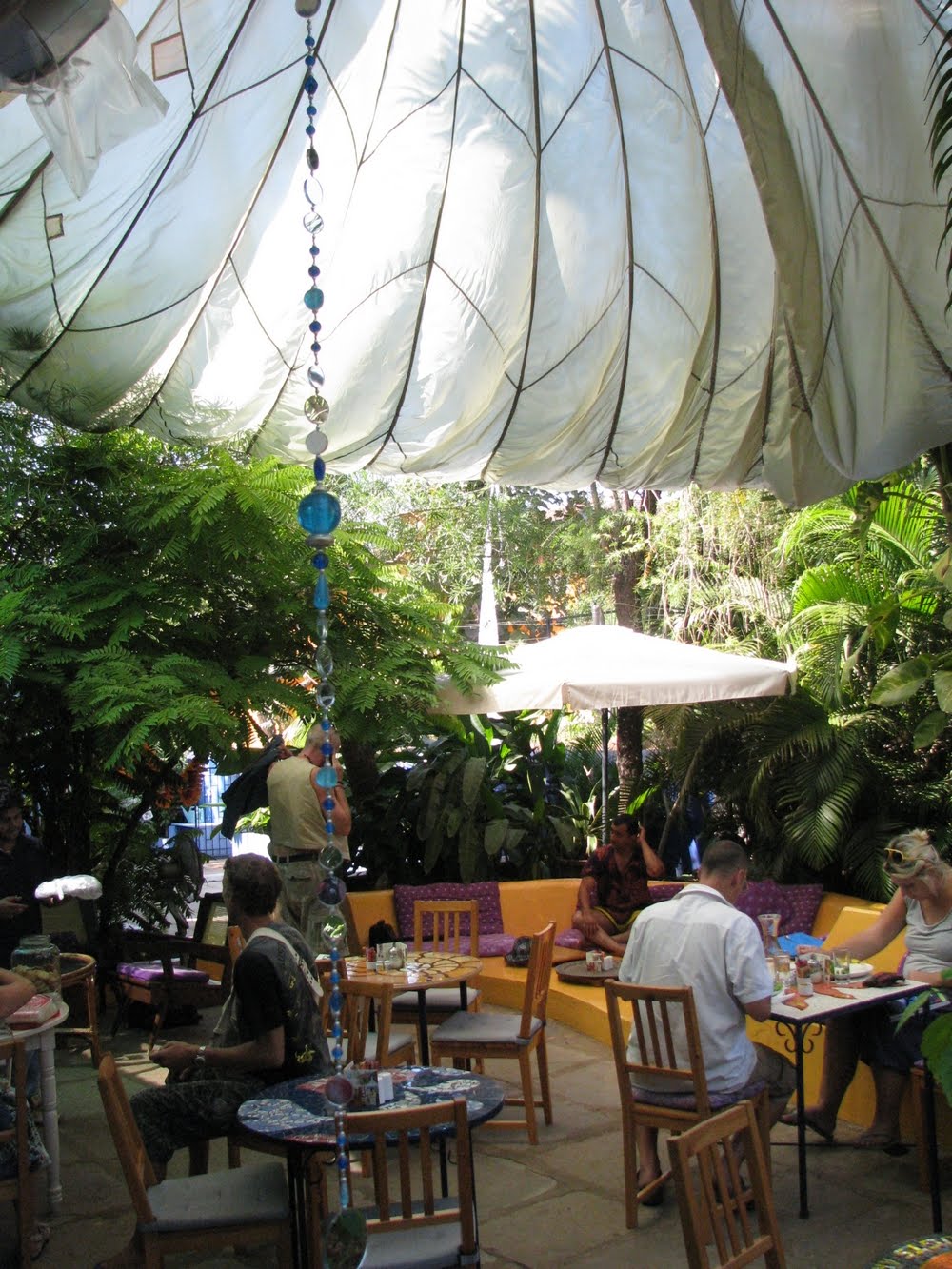
When we reached Villa Blanche, I was delighted to find it nearly match the picture I had in mind. Warm sunlit roads led up to this blue-and-white house. The house opposite it is also nice though (as I recall) it was in red. It wasn't noisy. There were a few bikes parked outside and I heard a tingling laughter come from behind the leafy barricade of the bistro. There is a quality of laughter that not everyone possesses - the ability to infect another with a smile. The mere sound of it, a distant view of it, and the observer helplessly smiles. Not all laughter is of the soul. We walked in, bowing through the arches of wild plants, and landed right in the midst of the cheerful Villa Blanche with Yogini smiling looking pretty in her spaghetti blouse and short skirt. She clearly carried the cheer of the place. She asked us where we were from and when we told her how we had heard about her place she was proudly disappointed to know that people all over India were familiar with her place. She gave me the picture that she would have preferred to be less popular but also acknowledged the renown her place was earning. I had come to taste the creation at this place to figure out whether it was just tall talk or the place really had something to offer. I must say it was well worth all the praise it had received.

I found the place like a hidden oasis. Bright colours without being gaudy marked the place and its decor. The canopy above looked like some torn parachute and made me wonder whether Villa Blanche really fell out of the sky. There were chairs and tables (topped with tastefully done mosaics) and there were also ground level seating options. We picked the latter since the tables were all occupied. I suppose we were the only Indians there (discounting the cooks and helps in the kitchen). Yogini continued to eye me suspiciously as I walked around shooting tables and hanging trinkets.
J was busy arranging cookies into small polythene bags and tieing them cutely with red and green ribbons. She was one of the most lovely-skinned ladies I had met in Goa. The attention she gave to her work impressed me even more and her sweet smile and lovely chin made me sigh. Yes, J was quite a beautiful lady without trying to be so. She was wearing the plainest frock and had tied her hair in a simplest crochet/woven net. She didn't wear any jewelery around her neck and the necessary pen clung to the cloth of her dress. She was from Germany (which perhaps explained her efficiency and accent). She will be J for this post as her name is not announced or associated with Villa Blanche and I don't know whether she would like her name spelled out here.
"Not all cafes and bistros are about the food" which isn't what I am using to say anything about the food at Villa Blanche. If the food is bad no matter what the ambience is, I will never go there again. Hence, I have to tell you that I often go to a place more for the ambience and the warmth than for the food. Hence, you find me describing the place more than the food itself.
Nevertheless, Villa Blanche offers good food but the ambience and the warmth of the place supersedes the quality of food. The food is lovely and fresh. Indians who do not like European, esp. Mediterranean, food should not even consider Villa Blanche (though there was tofu and peanut satay on the menu too). The food is for a mild palette and that is what I loved about the food. The salads were  fresh and the feta soft and salty. The dressing was deliciously light though the addition of sprouts seemed like a local adaptation (though I might be wrong there). I am told that the non-veg was good too. My main course was plain rice with fried tofu and peanut satay. Mild and nice though I had cool it down before Mufti darling could bite into them (before his master, Marco, ordered him to go "unter" a table). For dessert I had a cheesecake which was made according to a "grandmother's recipe". It was delicious. My friend simply kept emitting sounds of pleasure with each dish he had.
Contact Details:
Yogini (Mob: +919822155099), Badem Church Road, Assagao.
More pictures here:
Sunday, August 29, 2010
Mien Khum And Fragranced Rice with Thai Curry
In the midst of all the studying and pointless planning, I continued my perennial quest for culinary prospects. More than finding amazing restaurants, I usually seek out places which sell fresh vegetables (exotic) and herbs, not to mention cheeses, curry pastes (semi-exotic) and the like. I love Maison de Gourmets in Chennai and Bangalore, American Food market in Chennai and Food Gourmet in Bangalore. But none of these places ever served Kaffir lime leaves or galangal (though I did find it once at Food Gourmet) or shiitake mushrooms, let alone miso paste and the like. Even ingredients like brussel sprouts, zucchini are rare. I would manage with whatever I did find (including in Namdharis and other such joints in other cities).
Well, today made me the happiest. I really am the happiest man today and I doubt whether there is anything that can spoil my mood today (unless I meet a liar, hence, I am staying indoors!) I was hunting for some ingredients as today is Thai-day (you didn't know!?). Surely, I wasn't looking for kaffir leaves or galangal as I had nearly decided that they are only available to the major restaurants (especially at 4-5 star hotels). So I hopped from one store to another and wasn't satisfied. Hence, I decided to drive over to a Namdhari where I know that most of the ingredients should be available. I took this sequence of narrow roads to go there and saw some colourful activity at a house in a narrow gully. People were loading and unloading crates of yellow capsicum (bell peppers) and bok-choy. I simply had to stop and mustered requisite courage to enquire into their business. Would they sell me their goods? Yes, they said. Even if I didn't buy in bulk? Yes, again. Was there a minimum quantity I had to buy? No, only as much as I wanted.
I was simmering with an excitement which grew to unmanageable measures as I passed one crate after another. So that you may fathom what warmed the blood in my veins you must know my relationship with vegetables. I adore them. No, you still don't get it. I dream about them. Hmmm, nope! You still don't get it. Let me help you: I once swore that I would marry a garlic bulb and take a vegetable garden in dowry. Now you get it? Fresh, tender, sweet vegetables drive me crazy. I can simply hold each beautiful supple zucchini in my hand and cry or admire a ripe avocado for hours. Don't even ask me what I would do with freshly plucked cherry tomatoes and capsicum! So imagine my delight as I slowly walked past the crates. There was nearly everything I had ever imagined out there. Looseleaf lettuce, romaine lettuce, yellow bell pepper, red bell pepper, bok-choy, Brussel sprouts, basil, iceberg lettuce, zucchini and so many crates of wonderful veggies which titillated me no end. The only picture that came to my mind was of Po (the Panda) in the Jade Palace, hysterically going from one item to another.
To cut a long story short, I found all I wanted and more. This place happened to be the supplier for all the Taj hotels and other retailers. They even had kaffir lime leaves and galangal, rhubarb and so much more. The prices were much lower than what the retailers quoted. I got what I was looking for (except mushrooms) and had a wonderful Thai-Day.
The first set of pictures is my attempt at conjuring the delightful Mien Khum I once had had in Benjarong. The dish is amazingly simple but delightful once in your mouth. I had received bored and skeptical looks when presented this dish and predictably all of them transformed into surprised appreciation. The last dish is simply fragranced rice with Thai yellow curry.


Wednesday, August 11, 2010
Killer Red Pasta
So I have come to enjoy dry pasta. After having cooked several versions of it (combining anything from charred tomatoes to brinjal/eggplant wafers to drunken mushrooms) I have to come to realise that this is as much fun as the saucy versions. All the pictures below are shot in my kitchen (of which you get to see absolutely nothing). What you see is pretty much all of what I used (and limbs of baby-corn added as they were threatening to get spoilt!). Yes, the pasta was slightly overcooked. Was too busy shooting the images to remember that I had to arrest the cooking! Anyway, here goes...


Sunday, March 28, 2010
Vietnamese Rice Paper Rolls
That is what they were called when I ordered them in a Vietnamese restaurant in Ottawa. I fell in love with them. They were, what we Indians would call, satvic. I, of course, had the option of adding chilli sauce (which is not anything like a ketchup but an oil suspension of spicy chilli) to which I often sinfully subscribed, but this dish is splendid even without anything spicy.

There are about 40-50 sheets in a pack. You'd rarely want to eat more than 4-5 of them in one sitting (these are starters not enders or this-is-all-you'll-getters). There are tonnes of variations to this dish and I am simply going to tell you the tale of tonight's dinner.


What are the variations possible? Several! I would need a few hundred posts to outline all of them. Experiment with different vegetables (I would never recommend non-veg in this lifetime), different sauces, tofu, paneer, feta cheese, groundnut powder, gunpowder (something that you will get in Maharashtra) and so on. I have played around with several combinations including sun-dried tomatoes, harissa, soya sauce, etc. Be creative! That is really what cooking is all about, and of course the joy of feeding someone.
I returned to India planning a whole exercise of preparing these rice papers at home. I was sure my mom would throw me out of the house for making such demands of her. I then started looking for adapting Indian rice papads to serve as a coarse cousin of this dish's main ingredient, but, alas! nothing would really work. You could prepare rice paper at home. There is no one, other than your mom or, worse, your wife who could stop you. You would need rice flour, tapioca flour, salt and water. You should be able to find the recipe for this anywhere online.
The reason I love this dish (other than the satvic quality) is its adaptability. Like pasta, bruschetta and salads, this dish has a basic foundation (and hence, not entirely a free-for-all) but lets you mold it to suit your taste.
In Madras (and even in Chennai) you will find rice paper in Amma Nana, on Cathedral Road (opposite Park Sheraton, I think). In Bangalore, this is now available in Spencer's store on M.G.Road. This is the one adjoining Au Bon Pain bakery. I buy the brand below and I haven't been disappointed. Once, opened, please store it in a cool (not cold) dry place.

There are about 40-50 sheets in a pack. You'd rarely want to eat more than 4-5 of them in one sitting (these are starters not enders or this-is-all-you'll-getters). There are tonnes of variations to this dish and I am simply going to tell you the tale of tonight's dinner.
We had some tomato chutney remaining. I had to exhaust it. So, it formed the base on the rice paper. Oh! I forgot to tell you. The rice papers you buy will be firm discs. You need to immerse them in hot water for about 15-20 seconds. Take them out carefully as they will now be delicate and easily given into tearing. If you have long nails, cut them.


After applying the chutney, we introduce the tofu. Now tofu can be smoked, sauteed or deep fried after being dipped in besan batter. I chose the simple sauteed and one side charred option. But before I did that, I julienned (love this word) red capsicum (bell pepper), sauteed it in olive oil (extra virgin, which is not the same as a conservative Indian girl) and sprinkled a little (really, a little) salt and about 2-3 tbsp of balsamic vinegar. This softens the capsicum and lends it a tang.
In the skillet where I had sauteed the capsicum, I sauteed the tofu as well. You can use lengths of paneer to get a similar effect, but tofu is mild and satvic. So now my tofu helped me clean my skillet of the olive oil - balsamic vinegar blend. Then I turned up the heat to char (no, not your single byte variable) them on one side (you won't see that side below). The red worms on top are the capsicum slices. Please buy fresh.

Once you have that placed on the rice paper, you should add a few leaves of fresh basil. Fresh basil in Bangalore is available in the Food Gourmet store on M. G Road and I think in Maison Des Gourmets (Lavelle Road). You might find it at other places. In Madras you will find it in MDG (Senatoph Road) and in the American Vegetable Store in T Nagar. No, you cannot use dried basil for this. Please don't. Have a heart!!


Once you have that placed on the rice paper, you should add a few leaves of fresh basil. Fresh basil in Bangalore is available in the Food Gourmet store on M. G Road and I think in Maison Des Gourmets (Lavelle Road). You might find it at other places. In Madras you will find it in MDG (Senatoph Road) and in the American Vegetable Store in T Nagar. No, you cannot use dried basil for this. Please don't. Have a heart!!

Then, or rather at the outset, you should have powdered some groundnuts and dried red chilli. Then, you add them on top of the basil leaves. It lends a nutty texture and taste to the dish. If you are allergic to groundnuts (which are also known as peanuts) then don't use them. Duh! You could sprinkle some red paprika if it suits your taste.

Now, you need to carefully roll the paper (it is still delicate) making a nice translucent pouch containing all the ingredients mentioned above.

Now, you need to carefully roll the paper (it is still delicate) making a nice translucent pouch containing all the ingredients mentioned above.

And when many of them are carefully parceled, this is how it looks.

What are the variations possible? Several! I would need a few hundred posts to outline all of them. Experiment with different vegetables (I would never recommend non-veg in this lifetime), different sauces, tofu, paneer, feta cheese, groundnut powder, gunpowder (something that you will get in Maharashtra) and so on. I have played around with several combinations including sun-dried tomatoes, harissa, soya sauce, etc. Be creative! That is really what cooking is all about, and of course the joy of feeding someone.
Friday, July 24, 2009
Dark Delights
"What will it be tonight, my Aakah", she asked me in chaste Arabic.
Turkey, for me was the colour of her skin, alleys marked like her slender fingers, the pulsating domes curved liked her body with promises never uttered beyond the spell of her eyes. Turkey lived in my mind with the name of Yasmine; Yasmine who brought to me delights untold.
"Have I ever known what to ask, my love?"
She smiled through the veil and soft harp strings were plucked. Yasmine's is the world where singularity is an alien unless garbed as ecstasy.
"Would my Aakah prefer to sit down?"
With my will puppeted by her voice, I sank into the ostrich-feather couch. Like the reticent tear of happiness, she dropped with the rustle of silk to near my feet. She removed my shoes and placed them on hot lava stones while I shut my eyes. The walk of warmth up my body sang deep through the throb of my tired flesh. When I opened my eyes she was still at my feet but had produced a large shallow trough with special water (and how did she manage to not have a single ripple on it?). The candles swayed softly in the distant alcoves of her chamber, reflected by little mirrors appearing out of nowhere and rotating into a void. The floor danced to the long orange accompaniment of lamps housed in crevices in the wall and floor. One could walk on a flame and not be scorched while another step in a promising cooler corner might whisper an unexpected heat up your leg. Yasmine's world was not meant to be guessed.
With her hand supporting my heels she moved the stones aside and let my feet sink into the trough of ice cold shock. I lurched forward a bit and she immediately held me back with a firm hand.
"Aah, my Aakah is impatient?"
I leaned back with a smile. Her hand was still on my torso and she slowly let it move up to my collar bone.
"A tired day doesn't call for clothes, my lord", she said and with one deft snap removed the first button of my tunic from its eye.
"Or were you merely playing to entice your love?", and another.
"Could I ever forget the veins of my master?" Another
"Or are there new ones for me to play on the lute of my bosom?" Another was off and her palm rested flat on my navel.
"My ears do lust for new tunes, my Aakah." Another fell off obedient to the masterful flick of her wrist. She leaned over with her light breath falling on my earlobe.
"My whole body awaits your song."
I continued to feel that breath snake down my neck over my shoulder till I heard her voice from a distance.
"Would you prefer burgundy to black or red to emerald or ...?"
"Black"
The large candle she was facing glowed deeper with her smile and shook a wispy orange finger at me. She brought the silk scarf and extended it to me. I held it with both hands as she walked slowly to stand behind me.
"Black holds it all, my lord. All of it. The Gods created nights so that they could enjoy it all while we mortals groped around and fell asleep."
"Your world is not of mortals, is it?"
"Nor of the Gods, because their delights are written down in books."
She bent over, her long hair brushing my cheeks and the musk of her cleavage filling my being. While my body rose to meet that softness, the scarf was over my eyes and tied securely. Her feet whispered around me as she stood in front of me.
"What the eyes see is all the mind sees and hence, it is the Devil that leads man away from imagining, which is the seed of delight. Why do you need the Devil when you are with me, my lord!"
I smiled at her voice and she placed two finger on the scarf over the near corners of my eyes. Camphor? Whatever she had on her finger tips, seeped through the fabric and cooled my eyes and eased my entire being into a calm. While still holding the bridge of my nose her little finger traced the outline of my lips.
"How beautiful they are, my master! They spell lovely poems and tales and draw wet sagas along my breasts without uttering a word. One minute of sapping my breath with your verses and another of leaving me breathless."
My tongue oozed out to meet her finger, but there was none. She gently held the tips of my earlobes and said, "What's the hurry, when night such as these never end?"
She rustled to a distance and began playing her harp. I sat with a broad strip of nudity exposed to her with my hands lazily dangling on either side of the couch. As the tempo of her soft music increased, I felt something crawl up my shin.
"Don't move, master. For your own good. It wouldn't do well to be found dead in the house of Yasmine."
I stiffened as I felt something long curl up and crawl up my thigh. Its sheer weight told me what it was and it was then that I realised that the room was warmer than usual. It lazily moved up my chest and with every contraction of its body my hair stood taller around my neck. It casually moved up to my shoulder and I think it lifted its head. I felt a wet hair flick my earlobe before a long motionless hour seemed to elapse till the next movement. The chant of the candle flames grew loud in my ear and the harp strings sounded like from a previous birth. The scarf separated a worried and perspiring head holding a spinning mind within, from a stiff face which was thoughtless and entirely watching the being on my right shoulder. It gave one last  lick to my earlobe before slowly slithering away. The candles grew less loud and harp seemed more present.
 lick to my earlobe before slowly slithering away. The candles grew less loud and harp seemed more present.
 "The scent of the Yarabahi flower draws snakes to them but the taste of them is not interesting. So it is with any woman other than Yasmine."
She lifted my trembling hands and dipped them each in a jar of something which felt like soft wet flesh. I tried holding it between my fingers.
"Oh, you feel like pinching today?" and she laughed a tender cascading one.
Before I could say anything she rustled away.
"It wouldn't be fair if you are the only one naked, my lord."
I heard the soft sigh of clothes fall to the ground and felt every cell of my body alert and awaiting the next contact.
"Would you like to try this drink, my Aakah?"
She leaned over, resting her knee on the flesh of my thigh, and her breasts slowly grazing the hair on my chest.
"Na, na, na. No taking your hands out of the jars."
I let them sink into the gel which seemed to slowly move around my fingers and cool and warm them alternately. She placed a wet finger on the corner of my mouth. I licked the fluid. The sting arrowed to the roof of my head and I jerked and tried to shake off the shock. She kissed me on my forehead and placed another wet finger on the other corner. I was reluctant to try it now but it was seeping into my mouth. It was fruity and cool. I licked it all and her finger. She licked and smacked her finger.
"Now open your mouth, my lord"
I did finding it difficult to hold back a smile. She slowly poured a liquid which tasted different from the ones I tasted earlier, but a little of each was there too.
"Now pinch with the thumb in middle finger of your left hand and then with the thumb and ring finger of your right. Alternating."
I did as she told me, for who would not want to be led by the mistress of delight. As the liquid slowly fell into my mouth, each side of me gushed with a tingle as I released the pinching fingers. The liquid cooled in my mouth as it warmed down my throat. Yasmine slowly moved her hand and the liquid poured down my cheeks and chin, down the length of my body, pausing at my navel before moving further down. The throbs increased and I pinched vigorously. The marriage of the liquid, the warmth of the room, the gels in the jar, the nerves clenched with each pinch, my skin heating the wine as it rolled down and above all, Yasmine, yanked me from one high to another making me suddenly aware of each muscle and fibre of my being. The sweetness of the drink chimed in my tired chambers as I felt each drop of it sear my skin on its way down. As my breath grew shallower, I heard gentle flute notes waft around me. Yasmine was playing a tune which was vaguely familiar.
"Have you heard this before, my lord?"
"I... I think... I have."
She continued playing the tune and I could smell wild orchids. I leaned back with my hands out of the jars and my feet out of the trough. The liquid was drying on my front. The gentle notes soothed my heaving torso. I wasn't sure whether the smells of the flower were real or from the vague memories the tune evoked. She continued playing it while gentle faces rushed through my blackened mind; faces, mountains in the backdrop, tinkling laughter and children playing in the dirt, young women carrying pots of milk or river water, men working near large fires, soft yellow sunlight bouncing on every puddle and this tune from nowhere. People were busy selling their wares and having small market fights. Goats and chicken walked amidst them, occasionally startled at nothing in particular. Young boys grabbed their girls wrist and pulled them behind trees and resting carts. Elderly folks either shook their head or smiled in memory of days past. I was there watching all of this from above a huge haystack, writing in my notebook, when someone called out to me. I refused to acknowledge but the calls grew louder.
I know my bed without having to open my eyes. I smiled as the contours of my room drew themselves more clearly in my mind. She had managed to do it one more time.
"Come down, its already well into the morning."
"Coming."
I pull myself on my elbows and undo my tunic. She has left just a little of her drink on my chest. I scrape it and lick my finger. I spit it out in disgust. I look at my inner thigh and see the mark of a pressed knee. How did she let herself be so careless this time? I pull out my journal to recount what I can, but Yasmine did say that these were not to be written in books. But what use is delight when it cannot be one's trophy? What happens to a joy once it is put on one's window sill beside the rose bush? I put my journal back. Yasmine!
Sunday, April 19, 2009
Kaanda Batata Pohe
Also known as poha, this is quintessential Maharashtrian snack/breakfast. I suppose the Kannadigas would like to grab it as theirs too but they will simply have to sit back with their akki rotis and the like (anyway, the Maharashtrians have very few dishes to call their own so might as well be generous!). The Kannadigas call it Avalaaki making the dish sound quite complicated.
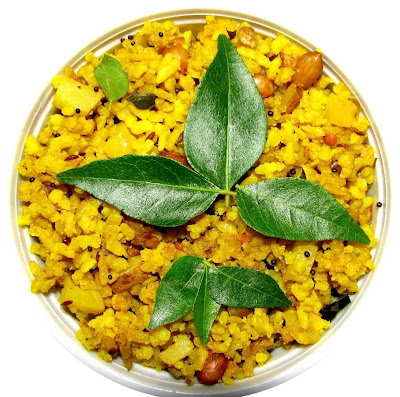
I wouldn't normally be writing about something that one might find anywhere (recipe, gyan, actual dish) but today I prepared this dish as a means to thank my neighbours. It was a sweet surprise when they made fried rice for me (mom's out and they thought I don't know how to cook) for lunch. In a world where creatures you think will help you shirk simple gestures with a "Just because I don't demonstrate my caring does it mean I don't?" and other lazy excuses for their simple incapacity to reach out and be affectionate, it did come as a surprise to me to find decent human beings right next door! :-) So I made this for them. I would have loved to prepare an elaborate meal for them but I had to rush elsewhere and gestures delayed (IMO) lose their value.
Pohe brings back memories of Pune to me. We had what was called Hostel Five Canteen or HCF. Most of us had our breakfast there and it was usually pohe and sometimes with sheera (maybe a post about that later). HCF was just a shack but we loved being there with the "annas" (or as we called the boys/men who ran the canteen). They would always load my pohe with extra roasted peanuts and they recognised our "gang" well. Somehow, we were like a family there.
What follows is one way of making pohe. As I would always say, improvise after you have understood the philosophy of the dish. One can make this without potatoes and/or onion but it is not called pohe then! :-)
Ingredients:

Poha (flattened rice. Here is a picture)
Turmeric powder
Mustard seeds
Jeera (Cumin seeds)
Whole peanuts
Urad dal
Green Chili
Onion
Potato
Curry leaves
Salt
Measures, you would need to figure out. Since I have never measured, it is unlikely I would be able to give you any.
Wash the pohe in a collander ensuring that any husk is washed away. Leave it aside for a while and then wash it again ensuring that the pohe don't clump together. Add turmeric powder to this (after 3-4 washes) and mix well. The pohe should be coated well with the turmeric powder. I usually wash the pohe once more after this but mildly (else all the turmeric will get washed off). Drain, add some salt, mix well and set aside.
In a wok heat mustard seeds, jeera and urad dal in oil. Once the mustard seeds start spluttering, add peanuts, torn curry leaves and chopped chili. Saute for a while and then add finely chopped onion. Once the onion becomes translucent, add a little salt and chopped potatoes (I leave the skin on). Saute for a while and then add a little water, cover and heat. This will allow the potato to cook. Once the water has all but evaporated, add the pohe in batches after squeezing out excess water (and this is important else your pohe will resemble upma). Keep stirring and ensuring that the pohe don't clump together. Mix well and ensure that the pohe get heated/cooked well. You must keep stirring continuously to get a dry texture for the pohe.
Variations include adding grated carrots, coconut and tomato. As I said, it is best that you understand the basics and then improvise.
Monday, April 06, 2009
Fun with salads
 This is the best way to get in as much colour into a healthy diet. Made with sauteed mushrooms, red bell peppers (capsicum), steamed corn and broccoli, kalamata olives, basil, rosemary, mint and grated paneer (cottage cheese) in a balsamic vinegar and lime juice vinaigrette. So we have black, white, green, yellow, browns and reds!! Ta-da!
Saturday, March 28, 2009
Maavadu/Vadu Maangai
It starts with people looking up at the sky and ponderously nodding (at nothing in particular). They would then appear rather serious and walk towards their favourite chair. Someone would have to enquire into their deep thought (a lot of life in a family is playing along and rewarding everyone with due cues and consideration) upon which the serious individual would remark, "Hmmm. I think the mango season is here. We must visit Mambalam market before the padis empty." Without exception this scene follows the day when the vegetable vendor or the flower vendor had informed this person about the arrival of mangoes in the market!
 Buying mangoes is an art as good as mango-Nostradamus'. I do all that is necessary to make the merchant believe that I know my business. I smell the little 'uns and roll them in my palm and rub them hard and smell them again and give a hard glance at the basket full of green pebbles (Goliath should have simply opened his mouth) and ask him the price while smelling again. Today he said, "Rs. 20 for a kilo". I looked at him disapprovingly and continued smelling. I asked for a knife. He was shocked and he wanted to lower the price or do anything that I wanted. I smelled the mango as if it were a rose (and I a Shah Jehan buying veggies).
 Maavadu is best eaten. With what? Anything or nothing. It is an ideal accompaniment for curd rice (with mustard seeds, and grated carrots and pomegranate seeds and fried urad dal and curry leaves and red chillies and... damn! Now I simply have to eat it!!) but goes well with rava upma and many other dishes. Enjoy!
Children would always be in awe of this person who is like the mango-Nostradamus. In all likelihood the kids don't know who Nostradamus was but they know what tongue-clicking green mangoes are, especially the ones that fit snugly in their fists. They always try to make the loudest clicks after a bite and suddenly a well populated and poorly guarded house sounds like the stampede of the stiletto brigade. Mangoes herald a lot more than mere taste and lazy afternoons with fistfuls of green gold; it speaks of summer vacations and visiting relatives and pickles. So now you know why mango-Nostradamus is so loved by the children of the house!
If you are wondering, why I haven't rushed into the pickle recipe, then you are probably new to this blog! You should probably thank your stars that I am not discussing browser performance and how Safari 4 is better than the previous version. Yes, you guessed it - this post is written within the frame of Safari 4 though I am always an Opera loyalist (can't help it with over 4000 bookmarks in there).
Maavadu is a popular pickle in South of India. It is debated as to which state should own rights to it, and I have just concluded that good, tasty maavadus belong to me. Simple. To those who think pickles can only be made by Priya, MTR, Bedekar, Ruchi and Mother's Recipe I have only one question to ask: How did the farmer manage to get the whole 250 ml of OJ into that orange ball?
Maavadu is made from whole, small raw mangoes - bonsai mangoes. They are probably the size of the pebbles David used against Goliath or in simpler terms, the size of a malnourished and out-of-shape golf ball. They are small, that's it. How else should I try describing that!? I have always had an issue with describing size. I could be pointlessly accurate in giving you the volume of the mango (314.594 cc) or I can describe them to you. Problem with qualitative description are that most of them depend on the dimension of your organs (easy! I mean palm and mouth and such). E.g.
- You could probably hide them in your palm. Issue: What is the size of your palm?
- 3 of them would fill your mouth. Issue: What is the size of your mouth. Another issue would be 3 of what!?
- If you pierced a moderately ductile needle through 2 of them and bent the metal between them, they should be just large enough to cover your eyes when you do not have the oh-my-god-she-really-did-that? look on your face. Issue: What on earth did she do?
So do understand my helplessness and humour me. These raw mangoes are small, about the same size of the pebbles David used to kill Goliath, measuring 314.594 cc (no, not Goliath!).
These mangoes come in two varieties. One is the rotund ones which are mostly what bounce on your mind's canvas when someone says "small raw mangoes" and the other is like the space between two "S"s, vertically offset and fused at their ends. The latter are called (in Tamil) kili-mooku (which means, parrot's nose or beak, the correlation is probably what the parrot knows! Sorry PJ). Kili-mooku pickles are tasty too but the mangoes are less juicy and more like a badly chewed gum. I like both varieties (and the gross descriptions are purely to discourage you from asking me for samples). Who am I kidding!! I am crazy about both varieties though my personal preference is for more flesh (guys! I am talking about mangoes. Yes, the edible kinds). The reason is that when you nibble at the rotund ones, the ooze with salty nectar which is why they are most loved. Frankly, if the previous line aroused you, it was unplanned!
I believe the best way to prepare maavadu is by recalling all that you did the previous year and how rewarding it had been. Pickles aren't pasta which in turn aren't crunching on a carrot. Pickles take a lot of energy and a lot of time. Results are typically known only in 10-15 days (and my mother snapped at me for demanding a tentative date when they are good to eat: What kind of an idiot would want a deadline for pickles!? They are ready when they are ready!! Now you can thank me for the more accurate descriptions in this blog). Pickles are passed down generations. Actually the recipes are! I learnt the recipe from my mom who learnt it from everyone except her mom and I have no clue where her mom learnt it from!
So this is how the story goes. My mom and dad were traveling in their early days as a couple (and in India, a couple then meant that they were already married). They reached Bombay (where all good things used to happen) and were supposed to stay at a friend's place. This friend was actually my grandfather's friend. They did stay there and my mother learnt her first version of maavadu from the lady of that house (yes, those were times when the ladies of the house knew how to cook!).
Few years later (when yours truly was already born and critiquing the food made at home) back in Bombay there was (I am sure she is no more) a kind lady whom we called "Vembu maami". To my child-mind (which hasn't developed much since then) it sounded irrational why she should be named after the bitter flowers of the Neem tree (in Tamil, those flowers are called Vepampoo and I would in my hurried talk pronounce Vepampoo and Vembu quite alike). I would also imagine her giving my mother the horribly tasting rasam (which we call saaramudu) made with those flowers. So I searched in vain, some bitter facet of that lady whose face I have now forgotten (I do remember their house and her entering the bedroom with the balcony where I was sitting awaiting sweets and pampering).
Vembu maami polished the earlier version of the recipe for my mother. The earlier version was a little saltier and not to everyone's palate. What follows is that version. It will follow, trust me.
Buying mangoes is an art as good as mango-Nostradamus'. I do all that is necessary to make the merchant believe that I know my business. I smell the little 'uns and roll them in my palm and rub them hard and smell them again and give a hard glance at the basket full of green pebbles (Goliath should have simply opened his mouth) and ask him the price while smelling again. Today he said, "Rs. 20 for a kilo". I looked at him disapprovingly and continued smelling. I asked for a knife. He was shocked and he wanted to lower the price or do anything that I wanted. I smelled the mango as if it were a rose (and I a Shah Jehan buying veggies)."Get me a knife."
He complied but stood his distance. I asked him to place the knife down as one doesn't hand the knife from one's hands to the other (it makes enemies of such folks, or so the belief goes). He carefully placed it in the empty basket without taking his eyes off me. I whipped the blade out and cut a sliver (actually, more than that). Holding it between blade and thumb I dropped it in my mouth. One bite and I was dying to click my tongue, but they were watching. I slowly nodded and asked him (yes, the bewildered one), "How many padis in a kilo?" For the uninitiated, padi is a measure which isn't standardised by the BIPM (and it never will be). Padi is pronounced puh-dee like maavadu is pronounced maa-va-du :-D
The poor guy thought I was from some arcane society out to mark him for trading in mangoes or something, because he swore an apology for not knowing what a padi was. I kicked myself for listening to my mom (well, she's twice my age and belongs to the era where an anna made sense) and asking him what she had asked me to ask him. He turned around and asked the majordomo. The latter clarified that they sell by the kilo. I said that I knew that but how many padis would there by in a kilo or conversely (and I actually said "conversely" in English because my Tamil or their Tamil wasn't good enough to handle "conversely" in Tamil). He said he didn't know so I smelled the mango again before instructing Mr. Scared Pants to give me 2 kilos. All the while I prayed that my mother doesn't kill me for picking mangoes unworthy of a pickle. I picked the pebbles myself and ensured that they were nearly all the same size (yes, 314.594 cc).
As I said, purchasing mangoes for maavadu is quite an ordeal. To the cynical few, all of the above could be accomplished within two minutes: Reach the shop, touch a few of the round ones (mangoes, guys), ask for price, buy two kilos, get back home and be scolded anyway! How boring! I am sure these are the same folks who wonder "Why isn't he giving us the recipe yet!?" God!
The funny thing with the market is that mangoes with about an inch or two of stalk are priced at 70-80 which doesn't make sense. Nobody uses the stalks for anything beside garbage weight, so why the higher price? The storekeepers were dutifully questioned to which they replied, "Because they have stalks!" Now you know!
The mangoes should be washed well and allowed to dry naturally on a dry cloth. I added naturally because I don't wish to field questions like "On a drying bed?", "On a desiccator?". Naturally, under the ceiling fan, if you must, on a dry piece of cloth. Ensure that there is atleast a stub of stalk left on each mango. Oh! BTW, I passed the mango buying test. Of course, I knew very well how to buy the right mangoes, and...
Once they are fairly dry, here is how your proceed (oh! yes, the recipe indeed):
For 10 Kg of mango, use 1 Kg of crystalline salt (that is white salt in sizes bigger than table salt but not bigger than the biggest gem you own. If you have really big gems, what are you doing reading this blog!? See? Same problem with describing sizes), 1 Kg red chili powder, 0.5 Kg mustard powder (not Dijon) and about 10-12 tbsp castor oil and about 2-3 tbsp turmeric powder. There are different ways to prepare this and I am giving you how my mother does it before getting into variations (some of them untested). Since you are never ever going to try with 10 Kg. let me talk in smaller measures. For about 2 Kg. of mangoes, use 200 gms of salt, 200 gms of red chili powder a little over 100 gms of mustard powder and about 2 tbsp of castor oil and turmeric powder by experience! Mom adds the mangoes into a large vessel and then gradually adds salt, tossing and turning the mangoes around (never ever use your bare hands as it might spoil the mangoes). Once that is done, in goes the chili powder with pauses and tosses and turns. Then follow mustard powder, castor oil and turmeric powder. All the while the mangoes should be tossed and turned to evenly coat the mangoes with the powders. Please rest assured that this current state of the mangoes is not how things are going to be in the days to come. I shall try to explain how.
Before I embark on that, a couple of points to note. As mentioned, never use your bare hands (though in India nearly everything is done with bare hands, pickles are an exception). Something about your perspiration or glandular secretions spoils the mangoes. Secondly, table salt is never used for pickles. My mother blames it on the iodine. I am merely quoting and following so I too shall blame iodine. Down with iodine! Thirdly, never let the pickles rest in a metal or wooden container. The latter will absorb all the water (oh! there will be lots of that) and the former will get corroded. Please remember these.
The typical container used for pickles is the Kerala Jaadi (as we call it) or the Bharani jars. These are beautiful jars made of porcelain in dual tone and are very very good for containing pickles. These have been in use for at least several decades if not a few centuries (and I exaggerate). One could also use glass jars but then the mystery of maavadu is lost. You will get to see the water collect and the mangoes soften and all the wonderful things that are best left as a mystery. So let's all use the Bharani jars. They come in various shapes and sizes and are quite aesthetic too. 
Once the pickle-amateur has been transferred to the jars, cover the mouth with a clean, dry cotton cloth and fix the lid tightly. I wouldn't recommend using plastic or anything synthetic. Leave this aside. Every day for the next 10-15 days (or as the high priestess says, "Deadlines!?") one must open the jar and mix the contents properly with a spoon/spatula. Cover with the cloth and fix the lid tightly. Do not forget the last bit (no, the eating come later). After about a week or so, it is recommended to taste the pickle. Only the experienced tongue knows the exact state of pickleness and can gauge the number of days left for pickling. It can, and I assure you, will vary.
There will be water (as God said to Adam when Eve broke her nail and was about to burst out crying). Osmosis assures you that the moisture content of the mangoes will be released. The salt attracts moisture too. All of this and the magic of maavadu assures you a lot of water. Soon your pickle will no longer remotely resemble the dry stuff you put into the jar on Day 1.
There are variations (as God said to Adam when he didn't understand what Eve meant when she said that she didn't want the parrot-green fig leaf but the teal fig-leaf as was shown on the Vogue magazine cover). Some prefer to add a bit of boiled and cooled water to the initial mixture. This creates more "gravy" which allows for mixing with rice. Some maavadus are not mustard based. Some people mix all the powders together and then pour it over the mangoes (like it matters). Some people make an even paste and "gravy" of the powders. Some people use fenugreek powder. Some people buy Mother's Recipe Vadu Maangai (oh! btw, maavadu and vadu maangai are the same but maintained distinct to confuse the tourist who lands in Madras). The latter category of people are ignored until when they offer some of their purchase. You take it and ignore them again till you are tired of ignoring them.
Maavadu is best eaten. With what? Anything or nothing. It is an ideal accompaniment for curd rice (with mustard seeds, and grated carrots and pomegranate seeds and fried urad dal and curry leaves and red chillies and... damn! Now I simply have to eat it!!) but goes well with rava upma and many other dishes. Enjoy!I just realised that I need to beg some other bloggers for pictures of mangoes, pickles and the bharani jars. Mom simply refused to let me take pictures. Reason: The pickles will get spoilt if pictures are taken (it is some interesting combination of the evil-eye, photosensitive mangoes, her touch and a few other phenomena that are best not discussed).
Thursday, February 19, 2009
Conscious Living - Food Habits
McDonalds in Tokyo is a terrible revenge for Pearl Harbour.
--Samuel Ichiye Hayakawa
(This is a fairly long post and should be read carefully. In case you are in a hurry, search for the word "Summary" and read thereon. The summary is not the same as the post!)
Food is vital to our being. We miss out a lot when we hurriedly summarise it as the "fuel" for the body. It is far more than fuel as fuel does not possess the capacity to alter or affect the personality of the machine it drives. Food is actually what we are made of and to treat it lightly is great injustice. I do not wish to romanticise the role of food in our lives, but if it is merely fuel, then we can always concoct a perfect potion of nutrients and minerals to provide to each human being and forget the entire idea of burgers and dal makhani. Beyond a mere gut feeling, I am certain that that will simply not work. Men cannot live (perhaps exist) purely on a dose of vitamin tablets and nutrient supplements. Try it!
Once we realise that food is not merely a bundle of nutrients, we can then move on to eating consciously. I do not hope that every (wo)man would cook with their heart and soul in it and make food the epitome of human taste (well, I would think it is), but to consume food consciously is vital and cannot be emphasised enough.
My mother and my grandmothers (both fine cooks though my dad's mom is fantastic) had a very simple rule as far as cooking goes: eat fresh food and do not be comfortable with leftovers. We are vegetarians (we do not consume eggs though dairy products are ok). Most of our meals are cooked fresh and are exhausted with that meal. Yes, it is time consuming but so are most other activities like surfing the net or watching TV or talking over the phone for hours or going to work or anything. Whether any of them nourish you or not is debatable but cooking food surely nourishes you!! Touche!
I was watching this French movie called Girl from Paris (why do they corrupt a beautiful title which means "one swallow brought spring"?). There is this beautiful (because of this line that I will shortly mention) scene where Adrien reminds Mathilde that a particular vegetable is not eaten in winter because it is not available in winter. He says something like "There is a reason why they are available only in a particular season." I thought that was so simple and true. I am sure the modern industrialist would think of a hundred ways to preserve it and ensure that they are available every single day of the year. I was reading Peter Mayle's Provence series (yes, this paragraph seems like I love the French. Honestly, I love humanity but ... anyway) and I thoroughly enjoyed their culinary adventures. The natives perhaps only cook rabbit throughout the year but plant different things at different times of the year and eat differently and according to seasons. Perhaps that is another reason for the French Paradox.
I think the primary problem with food habits is essentially North American (and British and perhaps other countries, e.g. Australia, with a similar society, lifestyle and thought). Most of Asia, Africa, South America and significant parts of Europe do not suffer from fast food, canned food, preservative laden food. Unfortunately, these "American" cultures are very good at influencing other societies to adopt their "cool" and "sensible" ways to nearly everything. A study and experiment by Kerin O'Dea with the Australian Aborigines proved that their adoption of a Western diet caused nearly all their health problems and when they returned to their native diet (including adopting the way they procured their food) nearly all their health problems reduced within a few weeks! There is no one diet that is perfect and I think it is vital to recognise that. The wisdom passed down the ages about appropriate diet and goodness is valuable and should not be ignored for fads and stupid wants for size-zero bodies!
Ayurveda treats food on par with medicine. Every food item has a guna associated with it and the person's body type is recognised before prescribing medicines (food or concoctions). The beauty of this science is its holistic approach to the body and the nourishment it gets. Ayurveda doesn't focus on the throat because you have a cold or merely on the shoulder because you have a sprain. To treat the body as a whole and to respect the role of each and every thing that we consume (air and water included) with due respect forms the basis of this science. Ayurveda goes beyond mere foods and medication to link the body with the spirit which people can brush aside till they read about alpha-waves in the brain and other recent phenomena and walk back in with the tails between their legs.
Though not Ayurveda, a recent study by TNSACS confirmed the role of nutrition and nutrient supply in the control of AIDS. So what we consume helps in many ways beyond merely being a "fuel". Let us bear that in mind.
This post will explore conscious food habits at various levels. Some of the m are:
Though not Ayurveda, a recent study by TNSACS confirmed the role of nutrition and nutrient supply in the control of AIDS. So what we consume helps in many ways beyond merely being a "fuel". Let us bear that in mind.
This post will explore conscious food habits at various levels. Some of the
 m are:
- How we grow them
- How we process them
- How we purchase them
- How food is wasted
- Choosing what to eat
- The unfairness of a non-vegetarian diet
When we worry about the way we "create" our food nearly everyone thinks about pesticides, chemicals, genetically modified crops and so on. I wonder why no one talks about how in-humanely the meat industry works. If you find it somewhere, do read Arthur Miller's tale where the narrator's wife (set in the Monroe-dye) throws back the fishes which got trawled in but are not the kinds people consume. So, the fishermen simply throw them on the sand and let them die there. She goes and picks each one of them and throws them back into the sea! A very touching story.
Have you visited an abattoir recently? Or ever? Do you know where your nicely packed chicken breast comes from (No! Chickens don't wear bras)? Or the bacon? Do you know how those animals were kept their living lives? What were they fed? How? Do you know how they were killed and cleaned so that you get that nice pink in your bulging sachet with chicken or goat caricatures drawn on them to make it look all very nice and cute and perfectly humane?
It might appear that I am making a case for vegetarianism. I would prefer everyone to be vegetarians but if you wish to eat meat then my appeal is different. I cal a conscious eater to be one who creates and handles his food with fairness and with some ethics. If you go out and hunt your meat with something that has a range less than or equal to five feet (so guns are out) then I think you are being fair. To have a few acres of living animals grown and cut up without giving them a say in the matter is ridiculously unfair. How would you feel if I raise a few hundred test-tube babies (no making love so no emotions involved) and subjected them all to manual labour or supplied them shrink wrapped to the cannibals of Andaman or Africa (if there are any left without being converted by some missionary)? Inhuman? Why? These animals are raised, separated from their mothers (I suppose fathers don't always count) and friends, simply taken into a stinking room and slit. Sometimes that death seems better compared to the horrible conditions in which they are made to live, packed like sardines in a can, sweating on each other with no hygiene. They would shit in the woods or meadows and not walk all over them, had they been left to themselves. Then comes the sickening act of choosing the breed (more meat, juicier, consumes less, etc.) and eliminating the ones you don't want. If you think I am making this up, then visit this link. There are many more such reports and "realities". If you thought this was a recent phenomenon, then read this. So, yes, I think it would be best to be vegetarian and if you are worried about the concerns that mis-informed non-vegetarians have about vegetarianism then don't worry: our family has lived for centuries on pure plants and plant products and most people have died due to natural causes (usually beyond the age of 70) or due to accidents (which has very little if any concern about dietary practices).
The great concern about Vit-B12 deficiency amongst vegetarians is mis-placed as no one in the family and in any family of relatives have anaemia. Stupid scientists have attributed the "Hindu" phenomenon (of being vegetarians and not having Vit-B12 deficiency) to the existence of insect larvae, eggs and faeces in the leafy vegetable and other vegetables. Seriously, are we to believe that we don't wash our veggies well enough and eat mosquito shit? If that is the case, then so be it. I'd rather eat invisible mosquito shit than disgustingly butcher animals. And, FYI, animals do not produce B12. We are capable of synthesising it and the entire chemical reaction of food in the oven as well as in our gut is far too complex to assume that we need all our nutrients on our plate in clear demarcated spaces and quantities before we can start eating.
If I were stranded in the Amazon (not the .com one) and had to find myself food, I might pick berries or hunt a rabbit and cook it. That doesn't mean that all planned and systematic murder is justified. To treat animals like a bunch of hub-cups off an assembly line reeks of our hypocrisy. To stuff them with what we want to find on our dinner table is also sickening. I know of cases where a camel (or some hoofed animal) is fed alcohol till it dies (or is anyway killed) and then the meat is marinated for a while before tossed on a spit. Very creative but so was using Jewish skin off the holocaust for lampshades. And if you let the body wallow in urine the skin is softened to provide easily workable leather which one can then shape into really classy handbags. Tanning such leather, I believe, is also very easy.
So feel free to fish and cook what you catch. Hunt a boar and carefully slice it (you can carefully scrape the "inside" of the skin to obtain fat which can be cooked for stuffing vegetables). Preserve them like they do in Italy or other Med countries. I recall a very elaborate procedure of hanging the meat with salt coating on it, etc. And if you are going to hunt them, welcome their hunting you too. Do not have some forest reserve authority shoot down a tiger which just attacked your house and dragged away your 2 month old daughter. You just had her cub last Sunday. Do not kill animals because you need to protect yourself. Protect yourself the way they protect themselves; with your body. If you believe that animals that behave unruly and kill human beings should be killed, then so should butchers. Is it remotely possible for you to be absolutely fair? Wait for your chickens to lay eggs. If you cannot hunt animals, then rear them and let them die. When they naturally do, then eat those dead animals. Yes, you will be called a scavenger. So what? I thought you liked the meat. There is nothing unethical or barbaric about consuming meat though it is atrocious and vulgar to consume meat the way it is commonly produced and distributed in most cities.
Have you visited an abattoir recently? Or ever? Do you know where your nicely packed chicken breast comes from (No! Chickens don't wear bras)? Or the bacon? Do you know how those animals were kept their living lives? What were they fed? How? Do you know how they were killed and cleaned so that you get that nice pink in your bulging sachet with chicken or goat caricatures drawn on them to make it look all very nice and cute and perfectly humane?
It might appear that I am making a case for vegetarianism. I would prefer everyone to be vegetarians but if you wish to eat meat then my appeal is different. I cal a conscious eater to be one who creates and handles his food with fairness and with some ethics. If you go out and hunt your meat with something that has a range less than or equal to five feet (so guns are out) then I think you are being fair. To have a few acres of living animals grown and cut up without giving them a say in the matter is ridiculously unfair. How would you feel if I raise a few hundred test-tube babies (no making love so no emotions involved) and subjected them all to manual labour or supplied them shrink wrapped to the cannibals of Andaman or Africa (if there are any left without being converted by some missionary)? Inhuman? Why? These animals are raised, separated from their mothers (I suppose fathers don't always count) and friends, simply taken into a stinking room and slit. Sometimes that death seems better compared to the horrible conditions in which they are made to live, packed like sardines in a can, sweating on each other with no hygiene. They would shit in the woods or meadows and not walk all over them, had they been left to themselves. Then comes the sickening act of choosing the breed (more meat, juicier, consumes less, etc.) and eliminating the ones you don't want. If you think I am making this up, then visit this link. There are many more such reports and "realities". If you thought this was a recent phenomenon, then read this. So, yes, I think it would be best to be vegetarian and if you are worried about the concerns that mis-informed non-vegetarians have about vegetarianism then don't worry: our family has lived for centuries on pure plants and plant products and most people have died due to natural causes (usually beyond the age of 70) or due to accidents (which has very little if any concern about dietary practices).
The great concern about Vit-B12 deficiency amongst vegetarians is mis-placed as no one in the family and in any family of relatives have anaemia. Stupid scientists have attributed the "Hindu" phenomenon (of being vegetarians and not having Vit-B12 deficiency) to the existence of insect larvae, eggs and faeces in the leafy vegetable and other vegetables. Seriously, are we to believe that we don't wash our veggies well enough and eat mosquito shit? If that is the case, then so be it. I'd rather eat invisible mosquito shit than disgustingly butcher animals. And, FYI, animals do not produce B12. We are capable of synthesising it and the entire chemical reaction of food in the oven as well as in our gut is far too complex to assume that we need all our nutrients on our plate in clear demarcated spaces and quantities before we can start eating.
If I were stranded in the Amazon (not the .com one) and had to find myself food, I might pick berries or hunt a rabbit and cook it. That doesn't mean that all planned and systematic murder is justified. To treat animals like a bunch of hub-cups off an assembly line reeks of our hypocrisy. To stuff them with what we want to find on our dinner table is also sickening. I know of cases where a camel (or some hoofed animal) is fed alcohol till it dies (or is anyway killed) and then the meat is marinated for a while before tossed on a spit. Very creative but so was using Jewish skin off the holocaust for lampshades. And if you let the body wallow in urine the skin is softened to provide easily workable leather which one can then shape into really classy handbags. Tanning such leather, I believe, is also very easy.
So feel free to fish and cook what you catch. Hunt a boar and carefully slice it (you can carefully scrape the "inside" of the skin to obtain fat which can be cooked for stuffing vegetables). Preserve them like they do in Italy or other Med countries. I recall a very elaborate procedure of hanging the meat with salt coating on it, etc. And if you are going to hunt them, welcome their hunting you too. Do not have some forest reserve authority shoot down a tiger which just attacked your house and dragged away your 2 month old daughter. You just had her cub last Sunday. Do not kill animals because you need to protect yourself. Protect yourself the way they protect themselves; with your body. If you believe that animals that behave unruly and kill human beings should be killed, then so should butchers. Is it remotely possible for you to be absolutely fair? Wait for your chickens to lay eggs. If you cannot hunt animals, then rear them and let them die. When they naturally do, then eat those dead animals. Yes, you will be called a scavenger. So what? I thought you liked the meat. There is nothing unethical or barbaric about consuming meat though it is atrocious and vulgar to consume meat the way it is commonly produced and distributed in most cities.
Vegetarians too need to be concerned about the food they eat. Lots of chemicals used and hybrid varieties (larger, juicier, longer shelf-life) not only taste bad (compared to the pedigrees) but are not good for your health (if you so fancy, please use a straw in one of the pesticide bottles and sip away). GM crops are a total no no. GreenPeace reports on how the main manufacturer of GM crops stopped the supply of its own produce in its own staff canteens!
Urbanisation and "civilisation" have sterilised us from the actual food production cycle and intricacies. We are happy in not knowing what went into that bowl of cornflakes we eat in the morning. Animals being fed something which is not their natural diet (so that we can get better beef) or plants being grown in unnatural conditions (though not for food, Bt-Cotton is an example of fudging with Nature) and the whole impact on land, water and air (the amount of greenhouse gases emitted by livestock is second only to the industrial gaseous effluents) are somethings that we need to closely monitor and perhaps make it mandatory to publish on the packaging. That wouldn't be of any use for packaged meats though a picture of the dead animal (whose meat looks so cutely pink) on the package might be good.
Processing food is not merely a matter of how as hinted above, but how we do things based on our ignorance. The way we whiten rice or manufacture all-purpose flour would reveal that our fancy for things white and clean make us lose a lot of nutrients (and they are simply washed away). Bigger tomatoes and potatoes don't matter. Smaller ones grown properly are tastier though of course you need to peel more of them for the same meal. Do not buy canned fruits and vegetables. They taste horrible.
You might wonder (as I did) how can this be avoided as long as we need to feed so many mouths. I will address this in another post, so please bear with me. Let us look into our buying habits and wastage.
Most people in the city prefer buying at the supermarkets. I do too because I can accomplish a lot in one trip and the best looking girls are there! But these are for emergency purposes only (to me). I always prefer buying at the mandis (the Indian equivalent of buying from a farmers' market to collective in the US or UK). Not only is it cheaper they are fresher and one can buy them in good quantities. Circumstances have left me with a separate refrigerator for my veggies. So I stock them in there and I don't visit a market for the next 2-3 weeks. I would prefer making the trip every week but logistics is an issue. Buy fresh vegetables from the farmers or farmers' union store them well and use them judiciously.
I overcook (somehow a whole wok full of coloured delicacies soothes me more than just a quarter full) and we have constraints on what can and cannot be stored in the fridge. But most often we would carry over to the next day. Do not throw away food. Feed a dog or the birds in the park. If the quantity is good and can be parceled, ask your maid if she would like to have some/all. We have some traditional recipes (so reducing wastage and recycling is very much in our culture and has been around for a few decades, at least) to utilise the greens and tubers that remain. One fantastic dish my mom makes (which my sister is crazy about) is the yericcha kuzhambu (burnt kuzhambu). I don't know the recipe and I think it is something made extempore (with some basic guidelines in place).
Another reason to avoid supermarkets is the amount of food they waste. WRAP recently published a report which estimated the food wasted (simply dumped) to be about 4.8 million tonnes per year. Do you realise how much people in Somalia would bless you for passing this same food on to them? Every year! No, this is not humbug. I referred to this link for an idea.
That is 2.55 million people's requirement for a month. UK alone wastes 100 times that amount per year!! Mind you, 4.8 million tonnes is the usable portion of the 17 million tonnes that is actually wasted! If we could only manage the 17 million tonnes well enough and channelise them to places where people are hungry, we would have a huge problem solved. But we cannot afford to live consciously as it is not profitable and it will not give us the sense of being superior.
What has all this got to do with Conscious Living? So much that we think it is a totally different and disconnected concern. Food is what people need (we can do without iPods and F1 racing). To be able to create them in a manner that doesn't destroy the fertility of this earth, doesn't ruin the air around us or pollute the water bodies on and below the surface of the earth is being conscious about how we produce our food. To assume that we can go on and on producing any quantity and hoard is being irresponsible. To think that we can change Nature and consider Nature stupid to have produced crops and pests alongside as well as seasonal crops (as in, why should I wait for the next crop cycle) is a typical trait of one who cannot think beyond his immediate wants (more, more, more) and conveniences (I should just have this rice which never dies). That is not living consciously. To treat animals as if they were created only to be lanced by our forks and spoons is immature and very self-centered. We can also be their food and they have every right to enter our homes and attack us and eat us. To protect the human race at any cost and treat the rest of the Earth and its inhabitants as variegated Granola bars is myopic and extremely destructive if not vulgar and outright barbaric. Whom we call barbarians were only so in matters of modern etiquette and in figuring out whether the fork should be to the right or left. They were genuine citizens of this world in taking only that much from Nature as they could return. Then greed and insensitivity crept in. Man lost all value for wisdom and kept manufacturing at a breakneck speed. We will surely not suffer any of the consequences of this mindlessness. Our grandchildren will and if you care only for yourself and your families, then please realise that Conscious Living is a focused effort to making life easier for your grandchildren (your family). This is not about caring for the child in Darfur (and you would only be human if you did care about that little one there) but about your own family. If you do not believe in expanding your circle of concern, so be it, but at least care about your grandchildren and the world you are going to leave behind for them. Shouldn't you pass on the best genes to them. Eat properly, then. Eat consciously. Live Consciously.
Allow me to summarise this rather large post.
Summary:
I urge every reader of this blog post to buy a copy of Michael Pollan's In Defense of Food. If you find it too expensive, drop by and we can discuss the book.
Urbanisation and "civilisation" have sterilised us from the actual food production cycle and intricacies. We are happy in not knowing what went into that bowl of cornflakes we eat in the morning. Animals being fed something which is not their natural diet (so that we can get better beef) or plants being grown in unnatural conditions (though not for food, Bt-Cotton is an example of fudging with Nature) and the whole impact on land, water and air (the amount of greenhouse gases emitted by livestock is second only to the industrial gaseous effluents) are somethings that we need to closely monitor and perhaps make it mandatory to publish on the packaging. That wouldn't be of any use for packaged meats though a picture of the dead animal (whose meat looks so cutely pink) on the package might be good.
Processing food is not merely a matter of how as hinted above, but how we do things based on our ignorance. The way we whiten rice or manufacture all-purpose flour would reveal that our fancy for things white and clean make us lose a lot of nutrients (and they are simply washed away). Bigger tomatoes and potatoes don't matter. Smaller ones grown properly are tastier though of course you need to peel more of them for the same meal. Do not buy canned fruits and vegetables. They taste horrible.
You might wonder (as I did) how can this be avoided as long as we need to feed so many mouths. I will address this in another post, so please bear with me. Let us look into our buying habits and wastage.
Most people in the city prefer buying at the supermarkets. I do too because I can accomplish a lot in one trip and the best looking girls are there! But these are for emergency purposes only (to me). I always prefer buying at the mandis (the Indian equivalent of buying from a farmers' market to collective in the US or UK). Not only is it cheaper they are fresher and one can buy them in good quantities. Circumstances have left me with a separate refrigerator for my veggies. So I stock them in there and I don't visit a market for the next 2-3 weeks. I would prefer making the trip every week but logistics is an issue. Buy fresh vegetables from the farmers or farmers' union store them well and use them judiciously.
I overcook (somehow a whole wok full of coloured delicacies soothes me more than just a quarter full) and we have constraints on what can and cannot be stored in the fridge. But most often we would carry over to the next day. Do not throw away food. Feed a dog or the birds in the park. If the quantity is good and can be parceled, ask your maid if she would like to have some/all. We have some traditional recipes (so reducing wastage and recycling is very much in our culture and has been around for a few decades, at least) to utilise the greens and tubers that remain. One fantastic dish my mom makes (which my sister is crazy about) is the yericcha kuzhambu (burnt kuzhambu). I don't know the recipe and I think it is something made extempore (with some basic guidelines in place).
Another reason to avoid supermarkets is the amount of food they waste. WRAP recently published a report which estimated the food wasted (simply dumped) to be about 4.8 million tonnes per year. Do you realise how much people in Somalia would bless you for passing this same food on to them? Every year! No, this is not humbug. I referred to this link for an idea.
Since commencing her EU mission, HMS Northumberland has safely escorted a total of 43,743.92 tonnes of assorted relief food, carried on six vessels over three different voyages. According to the World Food Programme, the above quantity of food will feed 2,550,000 people for a month.
That is 2.55 million people's requirement for a month. UK alone wastes 100 times that amount per year!! Mind you, 4.8 million tonnes is the usable portion of the 17 million tonnes that is actually wasted! If we could only manage the 17 million tonnes well enough and channelise them to places where people are hungry, we would have a huge problem solved. But we cannot afford to live consciously as it is not profitable and it will not give us the sense of being superior.
What has all this got to do with Conscious Living? So much that we think it is a totally different and disconnected concern. Food is what people need (we can do without iPods and F1 racing). To be able to create them in a manner that doesn't destroy the fertility of this earth, doesn't ruin the air around us or pollute the water bodies on and below the surface of the earth is being conscious about how we produce our food. To assume that we can go on and on producing any quantity and hoard is being irresponsible. To think that we can change Nature and consider Nature stupid to have produced crops and pests alongside as well as seasonal crops (as in, why should I wait for the next crop cycle) is a typical trait of one who cannot think beyond his immediate wants (more, more, more) and conveniences (I should just have this rice which never dies). That is not living consciously. To treat animals as if they were created only to be lanced by our forks and spoons is immature and very self-centered. We can also be their food and they have every right to enter our homes and attack us and eat us. To protect the human race at any cost and treat the rest of the Earth and its inhabitants as variegated Granola bars is myopic and extremely destructive if not vulgar and outright barbaric. Whom we call barbarians were only so in matters of modern etiquette and in figuring out whether the fork should be to the right or left. They were genuine citizens of this world in taking only that much from Nature as they could return. Then greed and insensitivity crept in. Man lost all value for wisdom and kept manufacturing at a breakneck speed. We will surely not suffer any of the consequences of this mindlessness. Our grandchildren will and if you care only for yourself and your families, then please realise that Conscious Living is a focused effort to making life easier for your grandchildren (your family). This is not about caring for the child in Darfur (and you would only be human if you did care about that little one there) but about your own family. If you do not believe in expanding your circle of concern, so be it, but at least care about your grandchildren and the world you are going to leave behind for them. Shouldn't you pass on the best genes to them. Eat properly, then. Eat consciously. Live Consciously.
Allow me to summarise this rather large post.
Summary:
- Eat just enough to last till the next meal
- Eat mostly plants
- Eat seasonal
- If you must eat animals, be fair to them. Give them a chance to fight for their lives. Look into their eyes when you hunt them.
- Cook slowly and carefully
- Eat fresh. Canned food is not food.
- Preferably buy your veggies and grains from the farmers
- Plan your meal such that there are no leftovers
- Buy only as much as you think you can eat (and deduct 20% on that estimate before buying)
- Pass excess food on to others who need them. Don't be insecure.
- Make it a point to visit or learn about the manufacturing process of the stuff you eat. By keeping it simple (veggies, grains, legumes, salt, spices, etc.) you need to spend less time on this.
- Try and enjoy at least one meal in a day
- Eat slowly
- Introduce colour and variety in your meals
- Exercise but do not adopt fad diets
I urge every reader of this blog post to buy a copy of Michael Pollan's In Defense of Food. If you find it too expensive, drop by and we can discuss the book.
Links: (I am not annotating them. Perhaps I will over time)
http://www.nutraingredients.com/Regulation/Food-policy-expert-fears-impact-of-nutrient-profiling
http://www.wrap.org.uk/
http://www.lovefoodhatewaste.com/
http://www.bbc.co.uk/insideout/yorkslincs/series7/supermarket_landfills.shtml
http://www.telegraph.co.uk/comment/3560306/Don't-blame-supermarkets-for-food-waste.html
http://www.greenpeace.org/india/campaigns/sustainable-agriculture
http://discovermagazine.com/2008/oct/12-man-who-aims-to-feed-humanity.s-future
http://www.ucsusa.org/food_and_agriculture/
http://news.bbc.co.uk/1/hi/sci/tech/7791854.stm
http://news.bbc.co.uk/1/hi/sci/tech/7753267.stm
http://www.frenchentree.com/france-food-cuisine/DisplayArticle.asp?ID=3033
http://www.timesonline.co.uk/tol/news/uk/article1527738.ece
http://www.environmentalgraffiti.com/business/5-reasons-not-to-shop-in-supermarkets/271
ps: Please forgive typos (if any) in this post. This was written in one sitting and the mind can only be this alert... Do let me know if you find any.
http://www.nutraingredients.com/Regulation/Food-policy-expert-fears-impact-of-nutrient-profiling
http://www.wrap.org.uk/
http://www.lovefoodhatewaste.com/
http://www.bbc.co.uk/insideout/yorkslincs/series7/supermarket_landfills.shtml
http://www.telegraph.co.uk/comment/3560306/Don't-blame-supermarkets-for-food-waste.html
http://www.greenpeace.org/india/campaigns/sustainable-agriculture
http://discovermagazine.com/2008/oct/12-man-who-aims-to-feed-humanity.s-future
http://www.ucsusa.org/food_and_agriculture/
http://news.bbc.co.uk/1/hi/sci/tech/7791854.stm
http://news.bbc.co.uk/1/hi/sci/tech/7753267.stm
http://www.frenchentree.com/france-food-cuisine/DisplayArticle.asp?ID=3033
http://www.timesonline.co.uk/tol/news/uk/article1527738.ece
http://www.environmentalgraffiti.com/business/5-reasons-not-to-shop-in-supermarkets/271
ps: Please forgive typos (if any) in this post. This was written in one sitting and the mind can only be this alert... Do let me know if you find any.
Saturday, January 31, 2009
A Dinner to Celebrate
Of course,  I have reason to celebrate. The reasons include a delicious dinner and hence I celebrated the day with a wonderful dinner! Of course, I knew that the meal will come out well and hence the celebration planned in advance for something in the future experienced now.
I have reason to celebrate. The reasons include a delicious dinner and hence I celebrated the day with a wonderful dinner! Of course, I knew that the meal will come out well and hence the celebration planned in advance for something in the future experienced now.What I prepared today was a take on Gordon Ramsay's Cream of Cauliflower and a simple pasta arrabiata (more chunky sauce). I think this is the first time I am making this soup and such a soup. I would love to give you the way I did it (I replaced mushrooms with aubergines because I didn't have mushrooms) but I think it is fair to let you read Gordon's idea and then let you work with it the way you wish to. I was delighted with the results (so I am sure Gordon's idea in its fullness must be wonderful too). I simply couldn't stop having the soup and then the pasta and then the soup and back to ... Sigh! Such meals should never end, but perhaps it is in their end that one can pause to register delight.
Friday, January 23, 2009
Use of the Genioglossus

I believe there is a particular way to eating Bengal sweetmeats. I suppose this is a class of sweetmeats which have a rosagulla like texture and constitution to any part of a fragment. I think the whole piece must be taken in, pressed to the roof with the terminal sulcus ensuring that most of the juice flows along the lateral border and into the receptacle temporarily constructed beneath the tongue. Wash your mouth in that juice and let some of it seep back into the porous pads of the sweatmeat (surprise!) and slowly chew on it. Slowly. Very slowly.
Wednesday, December 10, 2008

Monday, November 03, 2008
Saturday, November 01, 2008
Figuring out India in a teacup

Alliance Francaise de Madras made my evening today. There was a tea tasting, appreciation and awareness enhancing session directed by the management and experts associated with AvonGrove Tea. It was highly coincidental to find such an event scheduled the day after I was seriously pondering over the state of fine tea drinking in Madras. Lest you assume that I am a connoisseur of fine tea, let me rest all such eyebrow-raising notions. I enjoy drinking tea (without milk. Somehow the combination of tea and milk jars on my tongue) and own a special stoneware tea set which I employ for the ceremony of brewing and drinking my favourite teas, although it has been a while since I did that. Before I get to the interesting part of the evening, let me describe what lead to this rendezvous and tea tasting event itself.
It was just yesterday when I seriously thought of purchasing fine tea leaves (CTC is simply not to my taste) and blending them to various flavours. I had some ideas of various blends and even checked with my mother for the local Tamil names of some of the flowers that I would need to buy. All I needed was a tea leaf supplier. I needed the Chinese variety and preferably the green ones as I felt that that would help serve as a good base for my recipes. Oolong was also acceptable. Something about black tea made me feel that it was best left alone without blending other things in it. I shall share the recipes once I have them winning the approval of some of my friends.
Today I woke up to read an advt. about an event at the AF for tasting tea. They also announced the formation of a club which would engage in tasting various families of foods and beverages (I am told that cheese, wines and chocolates are on the cards). There is something about such promises that tickles me into believing them! I have often believed that the best work is done at the expense of individual energy. Many a time I have found groups withering to a pair or two of persons with a genuine interest in wanting to keep the leitmotiv of the group going true and strong, but suffering death by natural causes. Undoubtedly, once I went there, my hopes were raised (Mr. C seems to be quite a capable person). I was attracted more to the opportunity to taste tea as well as connect with some folks in the tea-world to better understand the prospect of starting and running a tea club and (inshallah) a tea bar in Madras (please don't insist on my calling it Chennai). I needed to understand the dynamics of the entire process as well as get a feel of how Madras responds to fine tea drinking.
I reached there when only a handful of ladies (can they ever be just a handful!?) had assembled to discuss someone and some things which I ignored with a clueless smile. They knew me not and such smiles work well in the midst of such an audience which is more than eager to ignore the newcomer. One thing that pleased my heart was the pleasant tone and the ladies carried themselves rather finely.
After some amateurish attempt at arranging the tea leaves (CTC was also up for presentation) and crockery, we were assured that things would commence in a manner which all of us looked forward to. I received, by a delightful stroke of luck, a suggestion to sit next to a fine lady whom I shall call GD. She turned out to be someone everyone seemed to know but that was irrelevant when juxtaposed with the effortlessness with which she spoke on a few topics with me. I have always been weak-kneed (or, as the Americans brashly say, sucker) for good conversation and she provided me a good amount, thank you.
Anand Kanoria brought a good measure of his enthusiasm to the presentation and occasionally took assistance from Amber Subba (garden manager) and Mr. Kidwai (of Carritt Moran & Co., I think). I would have preferred that he had prepared the presentation better rather than flip every slide with a "I won't be going into the details of this, but feel free to ask me questions". I felt that it was slightly rushed perhaps due to the delay that was already introduced or due to an undercurrent of low expectation from the audience to find anything of interest in those slides. For those who are interested in the process of tea manufacturing and Darjeeling Tea per se, I have the following references to offer:
- A good summary of tea manufacturing
- Manufacturing process for various tea types
- Manufacturing process with machine details (click on the links in the left frame)
- Darjeeling tea
- Tea Talk
I was definitely interested in the tea manufacturing process though I was aware of most of the steps that are involved. I was introduced to tea manufacturing when I was about 8 years old and shooting arrows in the misty slopes of Darjeeling. I remember buying and reading Hulk then. Most kids back then thought that green skinned superheroes were silly and nothing could beat Chacha Chaudhary and Sabu, or Phantom or Bahadur. I can safely laugh at all of them now!
I would have enjoyed it more had Anand and Mr. Kidwai provided more details. I was interested in knowing how the garden manager knew that the time was right or soon will be right for plucking (it seems, that the Autumnal could be figured out by the slightly xanthous tint of the fish-leaves (I think that is what they call the typical representation of tea leaves that one sees - 2 tender leaves with a bud in between)) and in other technical details of the manufacturing process. Polyphenols and enzymatic reactions could wait, though there was surely a lot to understand in the manufacturing process itself (and ponder over what could be done at various stages to produce something neo-tea-like. As in, consider the option of introducing Jasmine in the firing stage. How would the quality of tea change?). That didn't happen and we proceeded to tasting tea. Mr. Kidwai (and he has quite a sweet smile) let us enjoy the tea while he explained the various adjectives one could use when describing tea. "Malty" would be when your tea tasted like Bournvita! and "moldy" when you really are tasting something you shouldn't!
Mr. Kidwai gave us some statistics about the tea manufacturing process, the proportion of Darjeeling tea to CTC to orthodox tea and some more. It all went on well till a few of us gathered to discuss the state of fine dining (eating and/or drinking) in Madras. M of Maison des Gourmets felt that Madras was the last place one should even consider experimenting with (in the context of food). I wasn't surprised to find myself agree with him. Nevertheless, I soon saw where we were making a mistake.
People from Madras consider eating a chore and it would be next to impossible to convince them that something like fine dining is legitimate. For some reason I understand their confusion around why one should pay 650 for a dinner of kebabs (as was recently organised at the Pergola) when one could get good kebabs and grills at BBQ-Nation for less, and more kebabs at another joint for still less and eventually for nearly nothing when one can prepare them at home (these are times I regret being able to cook my own dinners. Folks use that as an excuse to dissuade me from going out)! I agree with the kebab case as the spread was nothing worth dying for, but there are places which provide food that is rare and very creative. And that is what brings me to my theory of food and fine dining in India. All from the leaves in the cup!
In India, we now eat to get on with our day. We eat to be able to honestly tick it off our list of activities for the day. I have seen zealous friends prepare a to-do list for a day and elaborately plan every task on that sheet but summarise all of eating in one of two words: "Lunch" or "Dinner". Coffee and tea are considered less confusing than "break". I am sure that this is the case with a lot of places in the world (perhaps not Europe!). As long as eating is a chore, fine dining is an extravagance.
But that was not how it was in India. Lucknow, for example, was known for being very learned in the biryani and kebabs that it produced. The people on the street who prepared food over large pans knew how to make mutton melt in your mouth (mutton never enters my mouth and hence, it has to be your mouth where all the melting will happen). Another gent I met in the evening recalls a person in Lucknow who could tell from the taste of curd as to how long it had been since it was set and where the milk came from (as in, cow or buffalo and not Ahmad's cows or Makhrand's buffaloes). People in Madras were very particular about the coffee that they drank (my mom's coffee was quite in demand) until Bru came along and made coffee drinking a chore, or as another seller puts it "Sip, lick, ummm". Even today many of my relatives will only have filter coffee and that too P-berry (or is it Peaberry?). We would have avial made in coconut oil and folks in Kerala cannot imagine chips made in any other oil. My mother never made vadai in Canola oil or the other "tchah!" varieties. I never allowed one-meal old morkozhambu anywhere near my plate. The quality of jaggery mattered a lot for the "paagu" (something like a treacle) that was made at home. Some folks even insisted on using water drawn from a well for their cooking. All these are examples of discerning gourmands in recent years. Several decades ago, we had tonnes of examples where every facet of a meal was carefully prepared.
What is it that went wrong, then? My bet is on the nuclearisation of families and accepting anything to sustain the driving ambitions of India Rising. We were raised to believe that being particular about anything other than our studies was wasteful and unacceptable. Food was meant to be eaten and quick! so that we could get on with our studies or extra-curricular activities. There was this one story which is etched deep in my mind. In a gurukula, a very earnest student was fed food without salt (I like my pongal that way). He never complained as he was always studying and never noticed this. One day, after several years, he suddenly stopped eating and exclaimed, "This dish has no salt." His master informed him that it was time for him to leave as his education was over and he no longer considered it the most important thing. That story always rang loud in my mind if I ever had to complain about the quality of food (I still did). There was of course the daily story that had a similar effect - with most of India not having enough to even eat for one meal, the very thought of fine dining was flayed with the guilt-whip cracking near us. Thus, the need to understand, appreciate and be creative about food was considered something that a housewife with lots of time at her disposal should do. It would be better if she could do that and help the kids with their homework. Or better still, just make something for dinner and help the kids with their homework. In middle class families with only one earning member, eating out (for a family of four) was something that could be done subject to budgetary constraints.
What India and Madras need is a gradual and carefully planned education about the goodness of eating well and fine dining. Why eat the same Dal Makhani on every outing when you could try some nice red bean couscous with bell peppers maybe at one third the periodicity? I think people need to be convinced to slow down, savour good food and be lured into consuming foods which bring out the best in whatever has gone into making them. Not that Dal Makhani is bad, but do you know how it really should be? Do you know what really makes it snappy? Is that topping of cream, merely design? What kind of beans, introduced in which order make the dish better (e.g. Urad too early can ruin the taste by bringing in the slime factor)? Do you think that once a person is made aware of this, and is then fed the perfect Dal Makhani, s/he would want to return to Pappu Dhaba's Dal Makhani? We are raising standards here, but that is the only way to go forward.
South India has been very exacting about dance and music. The tradition and schools of dance helped ensure that the strictest standards were adhered to. We have schools of sculpture and architecture but no institution of fine food. Ayurveda treats food as a medicine and Vatsyayana treats it as a decorative element in foreplay or part of the duties as a member of the family. Food doesn't seem to be treated as a wonderful uncut gem which one can polish and split into a beautiful ornament of satisfying beauty. Good food is at once orgasmic and Zen-like. Preparing it is verily meditation. Blessed are those who have experienced all of this.
Fine dining is an end to a very long and patient wait for people to realise the truth often achieved by exposing themselves, repeatedly, to whatever represents that truth. It cannot be wished into a society nor can it be forced. The worst thing to do is to introduce it at a very heavy price and then wonder why people lack taste and class. Why would I care for a Bose speaker if all I want to do is to listen to a T-Series tape while I sing along? Make me care, and I will walk your path.
I think it is wrong to assume that India does not have the taste or class to accommodate Darjeeling tea or chaji (Japanese tea ceremonies). I have personally, one person at a time, converted alu-jeera lovers to appreciate delicacies made of corn and mushroom (while making them realise why that alu-jeera was not good - hint: too much turmeric) with a dash of rosemary. It is a matter of evolving taste, and rushing it up can be detrimental to the very core of fine dining. The slightest financial setback will convince people that the first thing to cut out is this pointless eating that people call "fine dining". It needs to seep into the fibres of human hunger and not be merely an alternative. I think it is possible, but requires an extremely creative soul with tremendous amounts of patience. And in India, pricing it right helps.
It was, in summary, a very splendid way to spend an evening. I met a couple of nice people from the US consulate. It was entertaining and fit well into my oft-conceived but hardly-ever-realised notion of how an evening should be spent. Wonderfully delightful conversations (thank you Ms. GD), discussions about food, markets and tastes (thank you M and PS), fine tea, talk about fine tea and work life (I envy BD for having a job which takes him to different places like Romania and now India for short spaces of 2-3 years) and learning more about the world of tea and tea manufacturing (thank you Anand, Mr. Kidwai and Subba). Frankly, one of the best evening I have had in a very long time. Thank you Mr. C of AF for organising this.
Subscribe to:
Posts (Atom)