What would I do without a mind?
What would I do without a society to shape that mind?
To influence it?
To taint it?
To glorify it?
What would I do without the memories of such glory and such tache?
An orphan on a deserted island, with nothing from the outside world, save the produce of Nature which surrounds me.
I suppose I would be free....
What began as a volley of tweets between @soHbet_ & me led to some interesting ideas & finally a culmination on a plan to translate 81 (my idea) or 5 (hers) of Mirza Asadullah Baig Khan's (Mirza Ghalib) remarkable ghazals. While his stature is nearly set in stone & should need least effort to acknowledge, much more than we imagined was demanded of the industry in choosing, and then translating his words. Much of the difficulty I shall hastily assign to the incongruence of tapping one language's spine & hoping it would cough in another tongue. English is best suited for poets who think & feel in the Anglic tongue. Urdu is best when one seeks to build a flight of stairs for the Gods to descend & delight in poetry.
We picked this particular ghazal of Ghalib's, called Hazaaro'n Kwaishe'n Aisi. If you must read the ghazal in the Devanagari script (although there are couplets which Ghalib never wrote), click here. If you wish to read the Arabic version of it, click here. If we wish to download the entire Deewan-e-Ghalib (no translation, only Devanagari & Arabic scripts in there), click here.
No poetic interpretation is wrong. They are at worst a poor dagger (as poetic daggers come) to cleave your heart. We shan't ever know what the poet originally meant. Here is what I think he might have felt. Please note: I do not translate "nikale" as "take". I have merely chosen "take" to help me weakly adhere to the rules of ghazals. "Nikale" has many connotations as each line below reveals. It can mean any of the following: to lose, to arise, to depart, to emerge, to remove, to turn out, etc.
Hazaaro'n khwaishe'n aisi ke har khwaish pe dum nikale,
Bahot nikale mere armaan, lekin phir bhi kam nikale
Many are those wishes such that each, my breath did take
Many dreams have I lost (to Time), yet not much did it take
Darey kyun mera qaatil, kya rahega uski gardan par
Woh khoon, jo chashm-e-tar se umr bhar yoon dam-ba-dam nikale
Why must my tormentor fear that her neck shall have to bear
The blood, which in my tears this life's breath already did take
Nikalna khuld se aadam ka sunte aaye the lekin,
Bahot be-aabroo ho kar tere kuche se hum nikale
The expulsion of Adam from Eden is certainly much fabled, but
From your streets, my removal was with all the disgrace I could take
Bharam khul jaaye, zaalim, tere qaamat ki daraazi ka
Agar is turah-e-pur pech-o-kham ka pech-o-kham nikale
Should the illusion dissolve, vile one, on your stately mien
Uncoiling your tresses, revealing the truth, is all it would take
Magar likhvaye koi usko khath, to humse likhvaye
Hui subah, aur ghar se kaan par rakh kar kalam nikale
But must someone write to her, allow me to be scribe
Every dawn I left home & a pen, behind my ear, I did take
Hui is daur mein ma'nsoob mujhse baadah aashaamee
Phir aaya woh zaamanah jo jahaa'n mein jaam-e-jam nikale
Since then I've indulged & earned disrepute as a drunkard
Then came that time when the cup of revelations in my hand I did take
Hui jin se tavakko'h khastagee ki daad paane ki
Woh hum se bhi zyaada khastaa-e-teg-e-sitam nikale
In many I held the hope that they heal my wounded soul
But much worse were they in the jabs that Fate's sword did take
Muhabbat mein nahin hai farq jeene aur marne ka,
Usi ko dekh kar jeete hain, jis kaafir pe dam nikale
There is no schism in love, separating life from death
I live, gazing at the lover who, my every breath, does take
Kahaan maikhaane ka darwaaza Ghalib, aur kahaan vaaiz?
Par itna jaante hain kal woh jaata tha ke hum nikale
So separated the tavern door & the priest, Ghalib
Yet I recall, as I left the inn, the first step in he did take
As with all good poetry, mere translation is unsatisfying to the translator. What follows is my exploration into the possible meaning of it all. Please note, ghazals in their very design do not demand that the shers (couplets) be connected or related. Each sher can be about an unrelated theme as long as the rules are followed. You can find more about ghazals, here.
Is it merely my ability to extrapolate or is the ghazal genuinely pregnant with meaning? We might never know.
Ghalib uses the image of a lover, tormentor, assassin of the heart in different effects throughout this poem. While the lover could well be another human being, it might as well be one's notion of God or a state of being where none of these travails assail one. However, one wishes to shake interpretation out of that image, Ghalib wonders what frailty of the human soul spurs us to wish for more. One is well aware of the toll that hope takes on our soul, yet we succumb to its promise at the slightest ray of possibility. Some of us are such to not make much of all those wishes made & denied as if we can never have enough of being denied. The very fabric of wishing, cloaks us from what we have experienced & lays us bare to the thrashings of a new hope denied. Such is this desire to want, that stripped & clothed at once, we are in its throes.
Then what fear does any God or lover need to have? So powerful is this desire that I willingly walk into death, absolving all tormentors of the guilt of having driven me to there. In Urdu, "blood on one's neck" as translated from "uski gardan par woh khoon" is equivalent to the English "blood on one's hands" i.e. blame of misdeeds. A dagger's plunge does splatter the killer's body with blood. Ghalib asks - what does my slayer have to worry about? None shall blame the murderer who stands above a soul drained of all blood (life force) shed over a lifetime of tears (in wishes unfulfilled & hopes dashed). The utter helplessness of the soul is captured in this sher. Not only must he be a living dead, he cannot even hope for justice meted out to the tormentor but he must also reassure that murderer that s/he has nothing to worry about. Such is this soul's love for the granter of all wishes!
Often the celebrated one's trauma becomes more vital & renowned than what a common man walking the street goes through, but Ghalib avers, that his heart's implosion is perhaps more deafening if only we would cease to chant the tales of yore, of Biblical/Quranic/Tanakhic import which makes supreme suffering (in the common man's heart) petty by exalting the travails of Adam & other historic/mythological figures & thereby denying the sufferer even the right to feel comfort in that realisation that his wounds are indeed excessive & grand. Ghalib lends the heartbroken, belief-shaken soul an ear declaring that the dishonour was none less than the fabled disgrace of Adam.
Bharam is perhaps a corruption/variation of the word bhram (Sanskrit/Hindi, with the meaning of illusion/confusion). In Urdu it carries a possible connotation of "character or credit or worthiness". So at once, Ghalib cautions & praises the lover/God that either the illusion (of the God/lover's greatness) or the supreme fabric (of the same) would be revealed was he to tug at that twist of all understanding of the true stature of the God/lover. For a human lover, what he'll tug at would be the piled up tresses thus revealing the beauty or banality of the lover (the hair coming undone being the dramatic first suggestion to the following torrid love-making scene). For God that tassel to be tugged at would be to reveal the source of all Godliness & divinity, thereby either debunking the "God" as is popularly held or in the rapture of re-recognising what was the "original God". Either way, there are some who will be offended in the revelation & some delight in confronting truth in all its splendour. The unveiling, Ghalib says, will be convoluted & sinuous like the lover's tresses or God's "reality". Ghalib insists it is like the knot to which each generation has only added a twist & turn & wind but he knows of this one loose end which just needs a tug to find all knots & curls undone.
Ghalib, the ever-curious, insists on acting as scribe to all lovers/believers so he may understand the working of hearts & minds held in the hold of this magnificent beauty. Somehow he believes that by being the one to pen the letters to the God/lover, he would find the root of all suffering as well as the finest expressions of love which he may adopt in his personal letters. In being the scribe, he is laying bare the love of others for love, when described to another, making its innards known in words, is revelatory. By laying it bare he hopes either the lover sees the illusion of it all or Ghalib gains insight into the beauty of it. Either way, he always becomes the lover as he is the one writing what they wish to say. By being proxy to their gushing, he becomes the only lover that the God/lover will ever see. He becomes the essence of all lovers. And if nothing were to come of this, ever, he at least benefits by fuelling the writer in him. Thus Ghalib, in offering his services, stands to gain no matter what the outcome.
In pondering over love & being in the midst of lovers & pining for that one vision, Ghalib confesses to being drunk in the want for a clear sign. Such constant drunkenness earns the lover a reputation of a "madman" or "drunkard". Many will sober up re-earning societal accolades & good repute, but it is he who remains in that inebriated state who will find the portal to the worlds revealed promised in the mythological Cup of Jamshed's. Ghalib, being a poet, cannot discard the possibility that the madly intoxicating state a possessed writer lives in can very well be the gateway to all union with his lover/God.
Those who might come to aid to such a drunkard are dearly sought after, but most "wise" men are either feel-good godmen or priests blinded by words that were long dead. Thus, these men, cut by the sword of their respective Fate which brought them close to divinity & beauty but left them mere storytellers of a glory they have no clue about, these men, earn Ghalib's sympathy as a wounded soldier feels when he enters a hospital of a plague-inflicted town. These people who claim to right all wrongs, provide guidance to the passionately possessed or protect the ones madly in love are cripples themselves finding sanctuary behind their cloaks & social propriety.
For in love, absolute complete transforming love, there is no dichotomy of life & death, says Ghalib. Once in love, there is only loving. Once consumed by love, there is only that infinite existence gazing at the lover/God whose beauty takes away one's breath. Ghalib in one sweeping stroke dispels all cowardly love that treats love as an option, a practical consideration, a convenient avenue or a customary facet of life. None of that is love, says Ghalib, as the separation between living (and the practical choices) continues to thrive in opposition to death while that is impossible to be held thus, in opposition, in love. Ghalib's clarity in this matter of the heart is so simply stated but infinitely important & decisive. How can one be in love if there is a state of being that excludes the lover? Isn't love a complete immersion?
And everyone, every wise man, is aware of this though in fear turns his face away from this truth. The sheer intoxication of such love is beyond all rationality & plotting. One cannot to behave this way or that when in love as much as a convulsing epileptic cannot plan for his next seizure. This state of mindlessness unknown is frightening to the godly & ignorant alike. Were he not aware, why would he call me a madman, hiding his fear, his cowardice in invectives? He creates societal veils, moral walls to keep these who know the secret lest his cowardice be challenged, lest he be prodded to desert all sanity for the sake of a lover, it is easier to worship than to love. Thus, he pretends to keep his distance from the watering hole of such madmen & everyone chides Ghalib for even suggesting that the godmen must have an interest in the spirits. But, says Ghalib, he does recall many a day in his infinite past, when some godly men have risked entering the tavern of lovers, when they thought no one was watching.
With such ease, Ghalib moves from attacking desires & their multitude, to declaring how he too has been victim of human hope & want, bleeding dry, walking through all disgrace till he discovered that one key to all clarity. He jests while hiding his true intent of being completely immersed in the love of others as well as his. He then moves to describe the intoxication & why that is preferred to all sobriety. Such is this state that he realises that those who we are in the role to help are incapable to do so. He then summarises this state of love & its primary trait closing with the invitation & reassurance that all are welcome to this state of being as occasionally availed by the high priest himself.
While perhaps Ghalib might not have intended this, this ghazal is brilliant study in human psychology & even runs parallel to the Bhagavad Gita. In there, a confused Arjuna, besotted by desire to please, to conform, to gain the heavens, to be respected, approaches Krishna who assures him that the individual is neither killer nor killed, especially when the life is completely devoted to the Parabrahman. Krishna then reveal the one key to unlock all confusion, which he assures Arjuna is all truth. Arjuna then beholds Krishna in all splendour before being made aware of the complete immersion that bhakti brings about. The worth of mere word-content of the scriptures, & all purported aides (priests, et al) for the seeker is dashed to the floor by Krishna in later chapters. The oneness of the God in which life & death merge, where all dichotomy ceases is beautifully mirrored here in the ghazal as well. I am sure one can draw parallels to other works exploring the confusion of the spiritual soul.
Ghalib ensures that this ghazal is accessible to a common man who is in love as well as one who grows in love to seek the union with the Divine. Thus, in fairly simple words, Ghalib weaves a tapestry of remarkable import. Hope you enjoyed the work of this poetic genius.
There are 2 shers which are commonly inserted in this ghazal and passed around as Ghalib's work. They do not belong there. Their worth is not in question & is left to the reader, but their lack of authenticity has been ascertained beyond doubt. I will refrain from translating them.
The birds chirped not that day. Like the bulge of a river nearing an estuary, they knew that something unnerving was around the bend of Time, but what it exactly was, their unimaginative minds, knew not. This was the day when all changed and even the sharpest minds & most sensitive soul would fail beyond that bend of hours to conjure the fabric of breath before that day.
The Devil was on his evening stroll. He looked at the animals slinking behind trees & wondered why they would be so uneasy in the presence of He who guarded their souls from corruption. He walked to a fawn and placed his palm on her cheek. Going down on his knees, he held the fawn in the curve of his breast. All the other animals rushed to Him as did the flowers & leaves. There wasn't an infinite which could fill the expanse of his soothing, murmuring bosom. Behind the shield of his reassuring calm, he realised it was time to meet His brother.
It is strange how the ways of the Devil are. Movement is exaggerated & in that Time is created. Where he wishes not Time, the landscape transforms into the image in His mind while Time awaits a cue. Where he deals only in beauty & joy he withdraws not his pacifying tunes. Never has man known beauty to arrive & cease to be so except over time. When beauty is realised, it stays thus. In that realm, which is unbounded, in that moment, which is unclocked, in that breath, which is never exhaled, one unites with the Devil to recognise & realise beauty & calm like nothing of mental machination can summon from the most austere depths of arrogated chastity & holiness. Hence, the animals & flowers & leaves & the sagging bark of the eucalyptus tree felt a great peace against the caressing love of the Devil although the Devil was at that very instant at the doorsteps of God.
God was visibly disturbed. Not because he sensed his brother's presence in his mansion & certainly not because he had witnessed the affection of the creatures of the world he assumed was his. He anyway didn't care about the souls of animals or insensate beings. He had met Zinkalov in the morning & was unhappy. Zinkalov, along with Setura, was God's favourite creation. Zinkalov was given the mind of God's smile & the muscle of God's sweat. Setura was given the beauty stolen from the clouds (and what we see today up in the sky are just the breaths of clouds which once sashayed on this earth, gorgeous, spell-binding & voluptuous) & the eyes of the river Bhira. How the Devil collected the souls of these dying creatures is another tale which I will let Sdirut, the crow, tell you some other day. It should suffice to say that Bhira, who once was the vines to the heavens & home to all who smiled, nearly died without her eyes, till the Devil rushed to her side & gave her wetness in exchange for her eyes. Now do you know why rivers are wet?
Zinkalov hadn't done anything wrong. He was largely incapable of it. The Devil himself had tutored him. All he did was hum a tune when he had finished running many furlongs with Ghiyu, the leopard. Such was the joy that filled his inhuman heart that he couldn't help but break into a song of unheard tune. God was passing by & that sight & sound made him nervous.
The Devil walked into the room where God flounced between couch & window & floor. Light broke & coughed & shadows missed the lee of the world. At the sight of the Devil, light frowned & darkened. God turned to acknowledge his brother.
"Come, my blood."
"Greetings, one born from the same chalice."
"You fail not to remind me of misty days, Devil."
"One must only forget what was an illusion, my brother. The rest is the substance of our very marrow."
"I am not in a mood to argue, brother. Sit & drink some wine while I fret."
"Such wine wets not my throat, brother. Tell me, what ails you?"
"Zinkalov!"
"But he is your blood, brother."
"That doesn't rid him of the ability to crease my forehead"
"But how can one, whose every act is pure joy & entertainment, worry you?"
"Speak not as though you don't know, Devil. It might well be you who taught him these secrets."
"If my tutelage has produced one who is happy & sufficient, then I will never let it be a secret."
"Did you teach him to feel beauty?"
"I beg your pardon!"
"Did you teach him to open his heart & soul to beauty?"
"Most certainly we were heading that way."
"He seems to have overtaken you, dear brother!"
"Bravo!"
"What!? You revel in a creation that supersedes you?"
"Most certainly!"
"How ridiculous! Why create if you are to be made obsolete?"
"But how do I become obsolete?"
"Because he now knows how to experience beauty. He knows how to smile with the Sun & Moon. He knows how to sing with Bhira & her minions. He gallops with Ghiyu & revels in the breeze that caresses his visage. In all this, he doesn't need me. Why! He doesn't even need you. How could you teach him to be thus?"
"But why should he need you or me?"
"Why then are we needed? We who are the creator of all things, creator of Zinkalov & Setura - the most magnificent of all creations - will be soon forgotten as all these creations of ours revel in beauty & joy not needing us anymore. What is a God who will be forgotten?"
"But you will still be loved, my brother. Zinkalov, in all his sojourns, fails not to love you or laugh with me. Setura too shall learn to ride the winds & become fruit & fish while returning to her originally conceived form. In none of them will she love you less. What then worries you?"
"To be loved is less flattering than to be needed, Devil."
"And to be needed is more acerbic than to be hated, brother."
"What do you know! You need no one & no one needs you."
"Which is why I know."
God hurled a vase at his painting of tomorrow's sunrise. He shrieked & howled & trembled in rage.
"Shut up, Devil. I cannot allow my creation to not need me, to not funnel all their joy through me & only when I allow it, holding it back from them when I deem fit often for no other reason than to test their love for me."
"And that would prove what? That they do love you? That they don't have the capacity to love you through all storms? That they will love you only when faced with trials?"
"Whatever it proves it will provide me with their love & deny them the right to seek anything devoid of me."
"All it will prove is that you need them."
"How dare you!"
God in his rage flung his thunderbolt out of the window at Zinkalov & Setura as she began to learn from him to hum. In the blink of an eye God's creations were turned to ash & Devil smiled, for ashes are better than the bound. He left the mansion of God knowing he'd have to return soon to soothe God.
A sparrow's flight passed before the Devil decided to return to the mansion. As he walked in, he heard God's laughter & the bile rose to the tone of it. He ran up the stairs only to find God staggering over the balcony wall. The Devil rushed to hold him back & saw two creatures more beautiful than Zinkalov & Setura roaming the gardens of Eden. They were shaped beautifully & smelled like fresh dew. He also noticed that all trees were rooted to the ground & fish were not chattering on the swings but had taken to hiding within Bhira.
"Good evening, my brother."
"Devil, Devil! Aah! Just the one I want to see. See! Behold my finest creations, my brother."
"They are beautiful."
"That is Adam. That is Eve."
"When should I start tutoring them?"
"Never!" snapped God, scowling.
"Hmmm"
"I have taught them all that they need to know & also instilled in them great gratitude for being created."
"I see that the trees do not fly anymore."
"I needed something to create their mind with."
"And the chatter of fish?"
"That is my most remarkable trick, Devil."
"Whatever it may be, you cannot keep them from being tutored by me. All creatures have to be tutored by me. That is the agreement."
"Go on, teach them your stuff."
"You seem considerably at ease with that proposition."
"Because I am, dear Devil."
"You do know I will teach them to enjoy beauty & experience joy & love each other in ways I just invented over lunch. I will teach them ..."
"But in all that teaching", interrupted God,"You cannot teach them to do what will be their unbecoming & their very chain that tethers them to me."
The Devil looked puzzled & then remembered the fawn's shivering frame. He turned pale & so did all the roses in the world.
"No!"
"Yes, darling Devil. I did it."
"No!"
"Yes, yes, yes. I have taught them words. I have taught them language. I have taught them how to create more & more languages. I have taught them how to create scripts & sounds. I have taught them all the decadent ways of wanting to put their experiences in words."
"No!"
"Yes, my sweet not-so-clever Devil. They will soon write paeans. They will write tales & allegories. They will write poems & bleeding sonnets. They will usher in ballads & songs to cry their hearts out & woo their latest fancies."
"No!" whispered Devil, struggling to hold the balustrades.
"Yes! Your favourite love shall be quaquaversal degenerate, aching to be captured in words failing which, it shall be deemed non-existent or irrelevant."
"How could you!"
"Oh! I can do anything, dear brother. But you must listen to the masterstroke. After every slice of beauty captured in words, after every object is wrapped in sounds, when all that is felt is hurriedly scribbled as patterns that others ache to learn lest they miss out on "beauty", there is the lagniappe of my genius. When they do find or invent words for all their bursting feelings, they will always find them inadequate. And then, dear brother, they will turn to me whom - alone - they cannot express in words."
And the Devil turned to look at those two unsuspecting souls through teary eyes & knew what would become of him & the rest of his world.
Q: That which occurs when we are confronted by all sorts of shapes and forms is called ‘perception’. Can we speak of perception taking place when nothing confronts us?
A: Yes.
Q: When something confronts us, it follows that we perceive it, but how can there be perception when we are confronted by nothing at all?
A: We are now talking of that perception which is independent of there being an object or not. How can that be? The nature of perception being eternal, we go on perceiving whether objects are present or not." Thereby we come to understand that, whereas objects naturally appear and disappear, the nature of perception does neither of those things; and it is the same with all your other senses.
These are a pair of questions asked in Hui Hai's text called The Zen Teaching of Instantaneous Awakening. The entire text is beautiful in what it presents to the mind and soul.
I was repeatedly called to this paragraph when in my own personal experience I noted something. I was reading a prayer out of printed text. This particular prayer I am familiar with though I don't know it well enough to recite it by heart. Nevertheless, when I recite it my mind wanders all over the world in places I have perhaps never been an never shall be. But my eyes continue to flow over the text and recite them without my having to be conscious of what I am reading. And once I complete the prayer I re-run the entire episode through my mind to realise that I don't recall having read a single word though I did recite it all. To play voyeur to the mind is perhaps my most favourite means of passing time.
So here my eyes see though my mind doesn't seem to see and my tongue recites as if there is a direct connection between eye and tongue. With the mind having seen nothing, it might be inferred that there was nothing to be seen. Nonetheless, the eye did see and the tongue did recite. In other words it was as if nothing confronted me but I still perceived. This is certainly not what Hui Hai is implying but these incidents made me re-think our notion of "mind", "perception", "brain", "sensory organs" etc.
Completeness is a utilitarian want for something we'd rather have. Nature doesn't wait for the perfect apple to be formed or the most complete sunrise and though I do not call upon everyone to mimic Nature (oh! how I wish someone could), it is imperative of every artist and creator to observe Nature long enough to realise that this urge and need for completeness is utilitarian. No painting is every complete or completely exacting. A tree on the landscape received just a smudge of the brush, the face in the crowd didn't even get a nose, the claw on that cat was not drawn with the shades necessary, still they appear beautiful. A poem without subscribing to anyone's sense of completeness can still be beautiful.
A machine needs to be completely functional and properly oiled. Tickets need to be completely booked. Your order needs to be completely placed and the parcel completely received. Art and beauty cannot subscribe to a want for completeness.
We shall meet again next year, till then, ponder over this:
Beyond the point where the rivers End and the mountains vanish You have kept on walking Originally the treasure lies Just under one's feet You made the mistake of thinking That now you would be able To retire in peace Look: in your own hut the Meditation mat has never been warm.
Trying to find a buddha or enlightenment is like trying to grab space. Space has a name but no form. It's not something you can pick up or put down. And you certainly can't grab it. Beyond this mind you'll never see a buddha. The buddha is a product of your mind. Why look for a buddha beyond this mind?
As you take the bus on an overnight journey to some far away place, you stop where everyone must get down to stretch their legs or relieve themselves or grab a bite of the oily produce of the roadside vendor. While you get down wondering about what you have left behind and what you have waiting for you at the end of the journey - as if journeys end - you catch a glimpse of this extraordinary beauty haunching over a pile of vessels pushing her lovely hair behind her ear as she scrubs a wok. You stare at her wondering whether it is merely an illusion or her loveliness is real. How could someone so lovely be planted in the middle of nowhere scrubbing stained vessels?
The fate of the grand and remarkable placed in oblivion is a rude tragedy which reminds me of wonderful sunrises through which people sleep. How crude a joke when the finest nightingale sings her finest song only to be heard by none! So be it with Shakespeare composing sonnets while mopping the floor of Chittagong railway station or Da Vinci painting remarkable outlines along walls where people aren't supposed to urinate. Beauty stands insulted and neglected when confined to the amnesia of time. When the nightingale's song might never have been, what is one to speak of dulcet notes? When a lovely woman is not worshiped by many and stone doesn't chip itself into a monument for her, what shall we ever know of such beauty? The finest thoughts are so when they come out into the open. The cloaked phenomenon might never have happened. So be it with that sage who spoke to God but died before he could tell anyone about it. He was found on NH73, dogs tugging at his carcass.
Some readers might be aware of a bygone effort of mine in capturing my thoughts and meditations into 18 verses. On my recent trip I felt the need to understand when philosophical enquiry and spiritual pursuits seem appealing or even relevant to an individual. I also wished to understand what are the characteristics of a realised soul and what is available to him which infinite intellectual efforts (medha) cannot rein in. It is this very subject in its foggy constitution that leaves several amateur seekers (like myself) confused with the words of the wise and irritated by the chanting populace which resembles the mass incarnation of parrots.
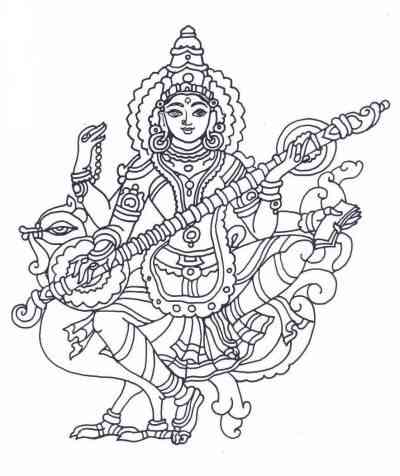
This post is an offering to the Divine Goddess Saraswati who effortlessly milks Truth from the bovine world in which we live. Were it not for Her, my life would be sadly meaningless, as it happily is now. In Her there is a union of mind and mindlessness. In Her there is a union of beauty and the banal. In Her there is peace. Om Shanti, shanti, shanti-hi.
This prequel discusses 3 matters vital to the reader before s/he even feels inclined to read the 18 verses. These verses (also numbering 18) are not questions but statements. They have been composed as verses adhering to the 5-7-5 count of a haiku though resembling the haiku in no other manner. Some might but most wouldn't as the subject is heavy and I am presently incompetent to douse such raging fires in a light linen handkerchief.
The first few verses cover the characteristics of individuals who would be inclined to philosophical enquiry. The next few verses detail the characteristics and circumstances which discourage one from spiritual development. The last few verses detail the traits a seeker must develop in order to effectively be able to meditate on the 18 verses. The post closes with 2 verses which apply to all philosophical schools of thought.
I will not elaborate on each of them as they are as delicate as the 36 questions raised in the original post. Poetry, unlike prose and laws, allow the fecundity of the mind to dictate the import.
1.
All jump to pluck the
Blossoms from the laden tree -
The roots go deeper.
2.
The monk wonders as
The fish gasp in the basket -
Which sutra they chant?
3.
The merchant's nine locks
And three guards at his vault - Still
A charm hangs on his neck.
4.
As he falls asleep
The buzzing bee near his ear
Begins or ends his sleep?
5.
A little orchid
Eddies past the praying monk
He smiles, bows once more.
6.
The tree in a seed
In a soft fruit's belly -
He slowly nods his head.
7.
The Yang-tze flood razes -
He floats on a bamboo mat
Eating from debris.
8.
He sows seeds; it rains
Hundred sacks of golden wheat
He dusts his bed and sleeps.
9.
When the nightingale
Departs, the li'l pup climbs the
Branch and barks. Confused.
10.
Ten fingers count sheep
Till one jumps over the other
Count all over again.
11.
The Spring breeze through
The orchards of apple blooms
Smells of apples.
12.
As I step into
The cold Ganges, I admire
My halcyon shadow.
13.
Come cruel Autumn
All tree obey and shed - Even
One which bore just a leaf.
14.
The mighty river
Too follows the plough's command
To water a rice field.
15.
Oh! Puissant hunter
Myriad arrows that left your bow
Rust on the wet grass.
16.
The lion mauls the deer;
Cruel? So necessary?
Manjushri's sabre.
17.
Sweet waters flow swift
Brine stands still gathering all -
One becoming another.
18.
A vagabond strolls
Through forest, marsh and towns - Paths
Beckoning his feet.
Yadakshara padh brashtam maathra heenantu yad bhaveth Tat sarvam kshamyathaam deva, Narayana namostute Visarga bindu maathraanee, padh paadhaaksharaanee cha Nyoonaani cha atirikthaanee, kshamsva Purushottama.
Ever since I joined my new company, I have been asked "Why did you join us?" several times. I have been creative and worded them nearly differently every time, but it really makes me want to provide just one answer. And there can be only one answer when you understand several of the underlying facets to a job and making a choice. Let me call my new company as T (since along with the first letter of my previous company it would give the industrial sector in which I work).
Before I get into that, I strongly disagree with people wishing to distinguish between their "personal" and "work" life. As if there is nothing personal about their work or they do no work in their personal life. I think there is but one life and there is a good mix of pursuits which are either intellectual or skill based, monetary in nature, aesthetic in nature and relational (relationships with people, other animals and Nature). Just because there exist various buckets of activities, it doesn't make sense to consider them counter-purpose. I am not talking about the time spent on each but what we bring to each as our character. It is obvious that while doing one task, it might be difficult to do another. But why would I want to be honest to one task and dishonest with another? Why would I want to be sincere to my wife, but insincere to my customer? Why would I want to be frugal at home, but use my office's resources as if it were infinitely available? Why should I be methodical and professional at work but consider it inappropriate in my relational pursuits?
I think if we stopped thinking of life as "work" and "enjoyment" then we can inculcate in our children the same equanimity towards the various facets of life. With our children empowered to look at life as a whole and not as something "that has to be done whether you like it or not" and "the fun you can have once you have done the chores" there is a great hope of a more conscious society. And this wouldn't be mere pedagogy but actual demonstration and embodying of values. Children will be discouraged to look at life as a dichotomy of the boring and the entertaining, as the professional and the casual, as the sincere and the it-doesn't-matter, as a chore and a passion. Even from an individual's point of view (whether there are children to raise responsibly or not) it is vital for one's own character to be Right towards every facet of our life. To consider it wrong to lie to your husband but ok to lie to your boss or obvious to move earth and heaven in order to get your child to the doctor but unthinkable of working extra hours to get your project out of danger reveals a complete lack of character in the individual and when continuously observed by a impressionable mind, this is what gets passed on.
We were always passed the message that work and going to office was the price we had to pay in order to have fun and the good things of life. Our theory of "no reward without pain" morphed into an example which we recognise as the work-life dichotomy. Soon, education, work, paying bills etc. all became the chores that we have to do so that we can go on a vacation in summer.
I have believed and felt the same. I used to think in the same way because I didn't have a better model of representing life around me. But with each progressing day, I realised that I was maintaining the divide more pronounced and sometimes even beyond the natural level of demarcation. It was becoming difficult to manage matters as it amounted to maintaining two personalities - one who enjoyed some portions of life, and one who had to put on this facade in order to go through the chores of living. In this split personality scenario, it is but natural that one views the activities thrust down one's throat with lesser respect and greater indifference and sometimes disgust. The chores became the villain.
Added to this is the emotional drama that relational pursuits bring in. To be sincere and committed to your work meant that you were a boring husband! To not trick your boss and be honest with him meant that you had no excitement in your life (look at Mr. Sharma! He got a medical certificate and took his missus to Singapoooor). To compare the energy you brought to taking Chintu to the doctor with the energy you bring to meeting deadlines is taboo because you are equating your son to a project which is merely work! How could you be so callous!?
Point is, no one was equating a human being to a piece of software. They are valuable in their individual places. What is being suggested is a single character that one takes to every aspect of life and living. Only knaves would recommend that one be honest to the Gods and lie to the Devil. I know of a person who told me, "E, how can you say thus? Work is work and Life is life. You cannot bring our work rules into your home" (and she wasn't referring to a dress code but the resolve to be professional and committed).
I think I have deliberated enough on this particular point. An honest man can only be himself in every minute of his life. Given that, he would want to use his time and skill in an activity which allows him to remain true to his self, true to his capabilities, true to his intelligence and true to his aspirations - be this activity a marriage or a job or an evening spent listening to music. Clearly there is no debate in that matter. If a marriage forces him to lie or not give him opportunities to love to the extent he can or respect his intelligence and goodness or clearly cripple his every single plan that he had or wanted to have in the context of a family, then such a marriage is a disease. So be it with his occupation.
Each person brings their unique combination of individuality, capabilities, skill, intelligence, sensibilities and aspirations. Hence, there is no one size fits all. For me, a life was fruitful if I utilised my abilities to create, ideate and learn with a good dose of humour and relevance. I tried to achieve all of this in my non-work aspects of life, resigning to the impossibility of finding these in a job. I think I slowly started moving my idea of a job away from being software engineering and started exploring other arenas where I could achieve this so that that would become my job and I could be myself in nearly all of what constituted my life.
I think a job must provide 3 ingredients - environment, ethics and excellence. Environment includes the people (colleagues and clients) you work with, the wisdom they bring, the location of your work, the tools available, etc. Ethics covers the values that an environment breathes and embodies. This includes the intra- and inter-environmental dynamics. Excellence is essentially recognising that there is the Right way to doing something and going about doing it that way. Excellence mandates a willingness to learn, to perfect and caring enough to only provide what is the Right output.
Depending on the quality of each of these ingredients, a job can be anything between horrible and Heaven. A job which provides an eclectic mix of professionals with a variety of experience and wisdom, sharing the same values, with a genuine sense of Goodness and Rightness which is revealed in their character and conduct, where the focus is on learning and growing and enjoying it all, where one's skill and intelligence is put to remarkably exciting use and in ways one hadn't imagined, where honesty, integrity, courage, humility and hard work characterise each individual in the organisation and the brilliance that each person brings to their task is a delight in itself, would be a job that would interest me. Add to this a sense of larger good, consciousness, relevance and a drive to empower the rest of the world in suitable ways to experience the same delight in living a holistic life where there are good relationships, good work and good interests pursued over a field of joy and fun and calm, and you have an excellent job to include in your life.
I think we put very little thought into why we want a job and what we want from a job. So when people ask me the question, I usually answer thus - Why I joined this place was to make a last desperate attempt at removing all divides and creating one holistic life where I work, relate, create, ideate and aggregate with one set of principles and soul.
It was a dear friend's birthday and we were taken out to watch this movie. In many ways we were three idiots of our own kinds, but nothing like what is shown in the movie. I could describe the Gold class seats and how my couch simply refused to recline until I got off it and so on, but that is largely beside the point. I enjoyed this movie in spite of the hype around it. I usually am doubly critical of a movie when it is hyped, but this one was good. Several characters and incidents were exaggerated for effect and there were factual inaccuracies too, but I think the message was clear: If you can live a life dedicated to your passion, then go for it. One thing I liked about the movie was how Rancho's character was built. They didn't portray him as a know-it-all or someone who was purely rebellious. Here is a character who can prove himself in the system but chooses to do things his way. So, he is not merely projected as a school dropout who goes ahead and builds a company all by himself or someone who flunks but still goes ahead to become some superhero. He is clearly shown as someone who loves his subject so much that he can succeed in the system and then do things the way he wants to - all on the wings of his love. He also shares this conviction of his with his friends who go on to lead happy lives (or so we are made to believe). The movie is quite light and there are several jokes and funny moments sprinkled throughout the movie. Many of those jokes are old and made to appear as if they were originally conceived by the author. Rather shabby in that sense. Boman Irani plays his character very well. For once, Kareena ceased to be a pain. I think Madhavan was good too. Chatur Ramalingam played his character well enough to evoke the distaste for him. I think the music wasn't noteworthy and not even something that I felt like humming after the movie (though one song might still pass). The message in the movie is rather old and not necessarily original but I think it is one which is worth repeating and this movie does so in a different style. Here starts the "boring" part. Today, a dear friend of mine sends me a link. She mentioned that it was a review against the 3 Idiots. She knows exactly the stuff that excites me and I always bite the bait to find someone intelligent enough to critique something with a strong and original tone. Given that nearly everyone was gushing over this movie, here was a chance to find someone who might impress me ("A worthy adversary!?" asked the lady to Thomas Crown). I am largely disappointed. Ms. Ghose raises a few points but unfortunately all of it is based on the fact that she missed the point of the movie. She thinks the movie "Three Idiots encourages us to throw away our books because today we are chanting the mantra, "the-system-sucks-and teachers-are-pathetic-and-who-cares-about-grades-and-the-rat-race-is- foolish"." Well, not really. Not at all, if I may say so. Rancho is there to learn. He likes to question. Teachers don't like students questioning them too much. I have been witness to this. Osho claims to have been witness to this. Not many people are comfortable with having their thoughts and rules and fundamentals questioned. Teachers, motivational speakers, gurus and most people up on a dais usually cannot stand such an audience. I have had so many people ask me to leave. Rarely have I asked a question in order to show off or irritate the prof, but over time, the system taught me to not bother these people and hack it out for myself or invent things. That helped me cook up stories for kids and also patent stuff (Rancho's 400 patents did make my eyebrows shoot up). Many teachers in my school and college still remember me as the boy who loved to ask (annoying) questions. Rancho loves machines and prefers things hands on. Nevertheless, he respects theory enough to study and score well in the exams. The point is, he wouldn't have had a problem even if he came 2nd or last in the exams simply because he would have loved every minute of the semester. That is what everyone was missing out on. I think all that Rancho was saying was that people should enjoy whatever they do or take some time out to evaluate what they want from life and their priorities. Viru Sahasrabuddhe was depicted as a demon in the form of a director, but he does receive Rancho's first question and does get back to him after Mona's delivery about the problems with using a pencil in outer space. So he was a good prof as far as the fire to learn, clarify and communicate goes. Yes, he believed that competition was all that the world had to offer. So many people believe in the same thing. Parents strongly believe in competition. Students learn the same and carry that attitude forward. Organisations are built on the need to compete and eliminate competition. So there is no point pretending that such characters (ViruS) do not exist and are figment of one's imagination. Some IITian on Ms. Ghose's article mentions the same thing "I have never seen a prof like how Viru S was depicted". Well, why didn't anyone say that about the teachers who subjected their students to capital punishment? When a child was made to lift bricks or run around the school in the sun, why don't we shun it as pure fiction and exaggeration because "We have never had such a teacher so it can't be real". Simply put, there are all kinds of teachers and professors and this movie depicted one kind. Can this work for everyone? Well, no. There will always be people who have no passion. There will be people who simply want a job and nothing more. There will be people who want to take the fastest route to a lot of money and social status. There will always be people who are passionate about life and as a wise soul once said, those who are passionate about life cannot be single minded about only one thing. There will always be people who can do a simple job when taught how to do it and that would pretty much be it. People who clearly are passionate about something constitute a meagre 1-5% of the human population. So is this movie made for only these people? I would think not. It is made to encourage people to pause long enough to ponder over what they really like to do, and if they find nothing then they could always pick a line of work which a needs large amount of labour force (like the software industry). Currently, people don't do that and that is a concern. If more people were encouraged to pause and ponder, there is a higher likelihood that people will align more with their area of interest/passion. Being in the software industry, I am surrounded by people who have come from all walks of life and are here mostly for the money and often for the opportunity to go abroad and get a better lifestyle. Very few people are here because they like to hack and develop software. I am sure every field has such examples. Bankers and teachers are rarely there because they love it. They simply wish to eke out a living. Nothing wrong with that but there might be opportunities to obtain a similar earning by doing something that they like. One teacher likes to cook, a banker loves painting, another loves collecting old movie songs and so on. Had they received sound guidance, then they could have juggled with setting up cooking classes (which can earn a lot) or provide catering services (which earns a lot more) and create paintings and setup shows and perhaps sell a good number of them and setup a radio show which plays old songs and people get to request for songs. Can they earn as much? Perhaps not. Perhaps they can be secondary career options. Perhaps we need to pause long enough to think. Rancho doesn't recommend that we kill the system. He suggests giving it a relook. He doesn't suggest we dumb down knowledge, but recognise what is relevant and what can be smoothened out to be more accessible. Rancho doesn't say that all teachers are bad but they need to revisit their teaching methodology. He doesn't say that engineering colleges are a waste, he says that they need to produce something vital and not a bunch of people who just want to use it as a stepping stone to higher paying jobs (even in unrelated sectors). Rancho doesn't simply point a finger at the education system but actually goes ahead and sets up a school based on what he believes. He doesn't say forget about grades but he says put your soul into it and enjoy the subject and success will follow on its own. Too philosophical? Perhaps, but if it can wake up a few, then why not. Human beings being what they are, are quite likely to interpret according to their convenience, but that doesn't mean that the movie is wrong or, as Ms. Ghose says, dangerous because it will create a nation of idiots. We are as much a nation of murderers and gangsters and voyeurs and Casanovas and silly fellows running through fields in Punjab because we watched movies depicting these things. I think we can live with it. If we anyway do not have the sense to think for ourselves, we can be a nation of idiots or Indians. Big difference!
A recent post found Pingu quote from the Hua Hu Ching (supposedly an unknown work of the Lao Tzu) and Parvati present her views on it. For those who find it tiring to look through the comments, here is the quote:
How can the divine Oneness be seen? In beautiful forms, breathtaking wonders, awe- inspiring miracles? The Tao is not obliged to present itself this way. It is always present and always available. [When speech is exhausted and mind dissolved, it presents itself. When clarity and purity are cultivated, it reveals itself. When sincerity is unconditional, it unveils itself.] If you are willing to be lived by it, you will see it everywhere, even in the most ordinary things.
Portions within [...] were not quoted in the comment though they form part of the original text. Lao Tzu is by far the only historic individual whom I shall ever consider to be a true teacher. There might be others but I don't know of them.
Writings on the Tao tend to stick a knife in their selves. By claiming that knowing the Tao cannot be described or constructed, they have made themselves open to ridicule, but Chunag Tzu would proclaim that state of being ridiculed to be a Taoist state. Let's not complicate things.
Parvati-ji responded as follows:
If I may intrude with a response to what you have said, here, Pingu,which essentially proclaims that all is the Divine, there is another quote from the Gita where the Supreme declares that the Divine on Earth is what is perfect. Perfection here, as clearly stated in all the verses starting from the 20th to the 40th verse of Chapter 10. Do read all of them starting from this link to later ones.
" Of the Vedas, I am the Sama Veda, of the senses, I am the mind, of the commanders I am Kartikeya, of the reservoirs of water I am the ocean, of all the divine sages, I am Narad Muni, of lordly elephants, I am Airavatha, of humans the King, of all the animals I am the lion, of the birds, I am Garuda, of the swift I am the wind, of the wielders of weapons, I am Rama, of the flowing rivers, I am Ganga, of the poetic metres I am Gayathri, of the seasons I am spring, of the Pandavas I am Arjuna, of the sages I am Vyasadeva etc etc.
" Certainly wherever and whatever is majestic, beautiful or magnificent, you must certainly know that all these manifestations arise from but a fraction of My Glory."
# I suspect that there are two fundamental truths of spirituality,
one is what you have quoted from Lao Tzu as all is the one Divine Consciousness, and the other is that on Earth and in manifestation this Divine Consciousness is a constantly evolving perfection in time and in space, whereby a present state of 'imperfection' can be criticised or if not criticised or condemned, its inferior qualities as exhibited by its errors and ill consequences in rightness and fairness can be discarded and fairer means that lead to a better harmony, but in truth and rightness can be expounded.
1. All is the Divine. This is an essential fundamental truth and an absolute
2. All becomes the Divine in the most outward and external manifestation too. This is in time as a growth from a lesser way of being to a more enlightened way. God too becomes in matter and material life.
The second fact justifies every single thought, discussion, debate that elucidates more and more, better and better ways to actually enable the Divine that is everything to actually be seen thus in matter too.
If mentally I understand that all is the Divine, and hence keep silence or kill my soul when I see ugliness or unfairness, assuming that evil too is the divine, then I disable a chance for me and my context to be redeemed in a greater light.
# Maybe the fact that I see unfairness and want it to be mitigated or annulled is also the divine and hence justified...
# Sorry, Eroteme, about this too long a response, maybe repetitive too, in your space. But Pingu's comment evoked such a comment from me. Do bear with me...
No apology required, Parvati-ji.
To summarise, there is one perspective where everything is the Divine and another where somethings are the Divine (or tending to the Divine) and some not of the Divine. The latter notion is also the source of the God-Devil duality. In the grand scheme of things, perfection and imperfection are both necessary parts of the whole. What Pingu quoted states just that; what Parvati-ji clarifies is a response to "Ok! So what do I do with that idea that all is the Divine?" Her words are a response to an often reached conclusion "Since everything is ok, let me do anything and everything and then simply call it the Divine and get away with it."
The Tao resonates with me and hence the notion of good and evil seem illusory to me at times. But there are so many moments when I see the vile clearly and am repulsed and propelled into action, thought or reflection. The Tao is not against action. The Tao is not against anything. To be one with the Tao (a state which seems so impossibly near to be true) implies a clarity and a freedom from conflict. The Tao guides the sword as it does the wind.
The problem arises when the ignorant mind clings to the notion of "All is the Divine" and then suffers the daily travails of facing the "bad" things. We want to believe that everything is the Divine but what do we do with this wretched liar who just robbed me of all my life's savings? What do we do when the immoral politician has taken over my piece of land? What do we do when someone jumps the queue? How can all of that still be the Divine?
Here we need to visit our notion of the Divine (which Pingu has quoted and Paravati-ji has elaborated on). We still believe that the Divine is beautiful and only the beautiful can be the Divine. Perfection is considered to be the Divine while imperfection isn't (though the Zen notion of wabi-sabi looks at things differently). We seem to view that all things imperfect are not-yet-Divine and in the movement from imperfection to perfection there is a move towards Divinity. Even the Gita says so!
Who then created the imperfection that seems to be more abundant than perfection? Why? Then is there a creative force on par with the Divine force? And questions keep pouring forth once we go down that track eventually ending in a conclusion that the Divine "itself" has been incapable of creating a perfect world and has created a world full of imperfect entities which need to continuously move towards perfection, or the Divine! Many souls are comfortable with that notion because the "worldly" acts of tests, challenges, missions etc. resonate with that idea of separating an entity (at the outset) from its perfect state of being and then making it difficult for that entity to become perfect.
But notions are just that: convenient beliefs to provide solace or security. They are convenient because one needn't dig deep to understand the duality of the Divine and the non-Divine. One needn't have to face Truth, least of all, deal with it. Who has the time, especially when one is busy trying to get that promotion, or that apartment or something equally important? Who has the time or energy when juggling a million tasks and responsibilities?
So we often tend to take one of two sides: The Divine is beautiful and all things ugly aren't (yet) the Divine (and the common Japanese view of individuals born with physical disabilities is one such example) OR all is the Divine (like the various new age gurus and cults say though they essentially end up creating a following which believes that their guru or their God is the true Divine and the rest is all humbug). The first category face lesser questions (not because there are fewer question but because there are fewer people willing to think deep enough to ask questions) and the second category face the questions like the ones Parvati-ji hinted at: If everything is the Divine, then is raping someone also a Divine act? Hell! no.
Confusion arises in actions and events (that seem to be related to an action). People see something happen and aren't able to explain it. Be it rape or thievery or the IPL cricket matches, we aren't able to explain how someone can do something like this to another person. Hence, we either call them all evil or smile over clenched teeth and repeat endlessly that "All is the Divine".
Action which stems from clarity is different from action which stems from ignorance. In the latter case it is one's own pettiness which drives action. When there is clarity then the action to protect a child from a murderer is as effortless as breathing. Once in that state, action and thought are not different nor motive forces for the other. In that state, the Divine is not a goal but the Divine simply is. In that state, when one is one with the Tao, Pingu's quote is obvious and clear.
Since most of us are not in that state, we seek ideals and goals which we can work towards. Krishna's words jar in my head more than they create resonance. Such a tone is the root of all misunderstanding and ill-formed thought and action. A lay man will shun all assuming that only that which Krishna said He is, is worth looking at or possessing or coveting. In the hands of fools, threads of gold will either be sold for a view of the Sun or they will be futile ropes to tether cows. Krishna is talking to a rather confused person who in the middle of the battlefield is busy raising queries which takes people a life time to understand. Krishna is immensely crafty and knows exactly how he needs to deal with a gentleman like Mr. Arjuna Pandu. After having told him so much and clearly that there is nothing in this entire universe which doesn't stem from Him and doesn't return to Him, Arjuna still asks Him for the "glories" of Krishna. To me, Krishna's bit after that sounds like pure pep-talk. He eventually ends it with saying "Amongst the Pandavas I am Arjuna" which hopefully did the bit! At the end He still wonders (perhaps with frustration): What necessity is there for you, O Arjuna, of such detailed knowledge and so many examples? (When I have been telling you that) I support this entire universal manifestation situated in but a fraction of Myself.
To miss verses 2-5, 7 -11 (yup, all prime numbers) and only focus on verses 21-38 (though I love what He says about feminine graces in 34. I really wish I could ever meet a girl who had those!!) is presenting oneself in a manner no better than Mr. A P. To invoke the Divine grace for a pep-talk is rather shabby. Had Krishna told Arjuna that "Well, I am the Divine and am the cause for everything. I am you and Duryodhana. I am the cause of your birth and of this war" then I wouldn't be one bit surprised if Arjuna ran back to Kunti telling Krishna to fight it himself and end it also by himself. Arjuna needed to know that he had the Divine on his side and that he was part of a worthy cause. Neither did Arjuna know nor did Krishna care to tell that to fight was being one with the Tao, because the war was meant to happen. Krishna with all his claims also died an anonymous death at the hands of a hunter who mistook his heel to be a deer's face! Krishna didn't simply vanish into thin air (like Master Ugway did). He died the way he was supposed to. Krishna wasn't without conflict (he actually charged Bheeshma when Arjuna let loose excuses for arrows, only to be calmed by Arjuna who was a few days earlier calmed by Krishna). He was surely one with the Tao for most of his life on Earth. So one cannot and should not take Krishna's words out of context, the context being
If we leave Krishna and Arjuna alone, we need to still come to terms with the following questions:
Is it possible to stay without an awareness of what happens around us?
Once we are aware, is it possible to be without recognising it as good or bad?
Once we recognise something as good or bad, is it possible to not react?
If we react, is it possible to figure out whether it was meant to be or not?
I will leave the reader with these questions, because it is sometimes best to live with questions than have answers.
It all started with that conversation. Actually, it all started several decades ago when I was born, but that is not how we mark events. R: "Don't tell me, E! Seriously? Yuck! Such horrible people!" E (that is me): "True." R: "I can't believe such people and families exist." E: "Now you can." R: "What happens next? What will he do?" And I began sharing the plans that our common friend had made before embarking on the need to establish Rightness. Commonly, one mixes Rightness with Truth, Honesty, Protocol and a few other things and is lost in the tangle of words and connotations. Few days later, a friend of mine complained that instead of dropping a Rs. 2 coin he had dropped a Rs. 5 coin into a beggar's bowl. He apologised to the beggar and asked him to return it in exchange of what was originally intended. The beggar refused to return what he had gotten out of chance. He: "Damn it, E! I know I was being stupid, but isn't it decency for him to return it?" E: "You expected a beggar to return what is not his?" He: "Yes!" E: "Then why did you seek to give it to him in the first place?" He: "Pity, good will, the need to share." E: "Then you will always have to pay more." These two conversations and my meditation on a facet of life, leads me to ponder aloud. Often one is faced with the concern of establishing the Right in various spheres of our lives. A Zen Master might wonder about how the Right can ever be established by anything other than the Divine/Tao/Rightness, which makes sense. Nevertheless, the land has her laws and people have rules because one cannot count on the Divine taking matters into Its hands and with this world having a generous proportion of vulgar scoundrels one is often faced with the need to establish justice and uniformity. There will be thieves who will walk into your house, act sweet and steal from under your nose and then claim that the goods actually belong to them. How many people have the patience to let the Divine resolve this? The Middle East would have those thieves decapitated and to some that is perhaps fair punishment. One could wait for Divine intervention and then find none, for which the Hindu scheme of thought has created the notion of Kali Yuga (Age of Iron): nothing will be as it should be. This justifies or rather seeks to explain the humiliation of the fair and righteous and the prosperity of smugglers and rapists, this justifies an early widowhood to a good girl and the pimping out of one's own daughter for a handful of gold (we often call them gold-diggers), this justifies the destruction of a Howard Roark and the pedestal for the Elsworth Tooheys.
I am frequently lost in the question: Can Rightness ever be established? Is there a point to it? Can we, while living in the midst of beggars and thieves and looters (Ayn Rand's choice for the worst amongst human beings), subscribe to Rightness and adhere to it? How common is the occurrence of a good intention, an ethical intention, an honest action gone wrong and twisted around by vulgar snakes forcing us to seek refuge in the intelligence and honesty of others? One would build a road with the genuine intention of creating easy travel and transport only to be condemned by the villagers of having ulterior motives and castigated. I have personally encountered horrible people who have twisted their inaction, laziness, lack of concern, lack of moral fibre into a virtue and into the oft used weapon of "being human". Such lowly people are a misfit in an ethical world. They resort to sweet words, drama, lies and falsehood in order to survive. They will take and keep taking (literally and figuratively) for they are looters who do not care for Rightness.
While fairness and justice can reveal a course of action, Destiny can choose another, though that choice doesn't mitigate the Rightness of things. Often one mistakes Destiny's ways to be a sanction of one's choices. I love the Sandman series where Destiny's role is beautifully sketched. Destiny is blind (and I like that volume where Rose tries to clarify to Dream that it is not Destiny that is blind but Love) and ensures that what is meant to happen will happen irrespective of the pleasantness or lack thereof. While one can carefully reveal the Rightness of things one cannot expect Fate to take sides. I think this is often the greatest torment man faces - the inability to come to terms with the actions of Fate which seem to come about irrespective of the course of action one takes and the underlying intent.
Allow me to consider each question independently and in an order that makes sense to me.
Why should Rightness be established?
What is the most vital context in which Rightness must be established?
How could/should we respond to the environment?
Is all the effort worth it?
Can it ever be done?
Why? Rightness is not negotiable. Rightness needs to be established because the absence of it is pure chaos which the human race cannot manage (which is not necessarily bad and at least, as The Joker puts it, "Oh, and you know the thing about chaos? It's fair!"). It is perhaps out of the fear of the absence of Rightness that Rightness is sought, but Rightness lends a flavour which is unlike that which arises from achievement or cunning. The only reason for establishing Rightness is itself. One can list a million reasons for why we need sunlight or water but Rightness doesn't find in human beings a necessity to quench. Nevertheless, Rightness is vital to the harmonious coexistence with Nature.
What? The context is the self transforming into the Self. Hence, Rightness can never be sought in an entity outside of oneself else Rightness would cease to be so and morph into a gimmick or a realisation based on popularity votes. It would be tragic and defeatist if one had to seek votes to decide whether something was right or not. Hence, Rightness cannot be sought or demanded outside of oneself. This doesn't mean one refuses to recognise its role in the common spaces between human beings, but the self is most vital context. This might sound like an escape from the seemingly original intent of this post to arrive at a strategy for establishing Rightness, but no, Rightness must be established and the most vital context is the self. Once it is established in the self, there is a channel for Rightness to permeate the space around that Self. When an individual acts as an impediment to or an inappropriate carafe for Rightness, what then is there to expect of the world outside such an error?
How? By observing oneself. To observe oneself is to rid oneself of the need to measure, to compare, to tally, to seek approval. When we truly observe ourselves, we watch our ways afresh. We do not compare it with an ideal, or with our beliefs or with norms. We simply watch and understand what is it that drives an action. I can watch my decisions and realise that my choice of taking a hard stance is simply my need to refuse looters to have things their way. My discomfort with liars and knaves leaves me with a visceral want to oust them from my life. I don't see it as good or bad nor wonder whether it is politically correct or what will others say or will I have as many supporters as the looters do or anything along those lines. This doesn't make for a justification for knee-jerk reactions but to be able to observe a sequence of actions and be able to realise where it all springs from lends clarity and with clarity, one has an opportunity to adhere to Rightness. Clarity alone is impotent esp. in the world of human beings. A friend often said that clarity to a person should be like a flame shown to butter - there is no choice, transformation is inevitable. Unfortunately, that is not true as far as human beings are concerned. One can heap facts and figures in front of a person but fail to convince a liar of the truth in them. They will stick to their illusions and condemn you for pursuing them with facts and truth. They will even resort to escapes and drama and blame you for "numbing" their senses with incessant calls to Rightness. Human beings can never be butter (and perhaps that is what encouraged the Vedic rishis to offer butter to the sacrificial fire). Hence, by observing oneself one has the opportunity to befriend Rightness. One would have to get over one's fears, one's hubris, one's false spine, one's ego to be able to walk the path of Rightness with the clarity gained. How should one drop one's fears or pride? There is no step by step procedure for that though the best means is to observe the world. One should observe it to see what is, what was and hence, how the world accommodates the transition from what was to what is. In this, there is great learning especially about the impermanence of things and ideals. There will be no man-made object that will outlive this world yet the world gently accommodates all mistakes and misunderstandings. In watching and observing Nature there is a lot to learn, esp. that our fears our primarily imaginary or irrelevant in the grand scheme of this world. That our pride achieves nothing on its own and it doesn't serve as sufficient trophy after we have created something. So, in observing the self and Nature one gathers the rudimentary equipment to adhere to Rightness. Those who aren't interested in Rightness will only talk, and lie and invent more lies to justify their inconsistent stories and play this silly game of them against themselves and clap hands in having won the game although there was no one else playing. They will create movements and expend energy in extolling the virtues of mediocrity and vulgarity because only in such a world can every rat be virtuous. They will appeal to your sympathy and not your respect for one can be gained through coercion and cunning while the other can only be gained by mettle and intellect. For one who is established in Rightness, there is no guidance necessary to establish that Rightness outside of him. His is a fire that will burn wrongdoers or himself - because in death there is no loss and with death ends the journey of the Right. That fire which has burned Right till the death of the torch is a true flame. Such a man refuses to accept injustice and will not comply. Laws of the land might bind him from fear of facing Truth. People might ostracise him out of fear of having to look into their own souls. But Nature will nurture him. The only way to establish Rightness is by:
Sharpening the blade of the self by observing
Refusing to accept the vulgarity of anyone around us
Sticking to truth and honesty
Sticking to a ruthless pursuit of fairness
Standing up for what is Right
Considering no loss greater than the loss of kinship with Rightness
Never giving a man more or less than his due
Never accommodating a vile individual
Never gaining from the association or favour of a vile individual
Never acting on pity
Never supporting a parasite
Preferring wisdom to mental intelligence
Preferring mental intelligence to emotional hooks
Preferring nurturing and support to parasitical coercion
Understanding the difference between being alone and being lonely
Comfort with being alone (for there is no greater companion than the Self)
Willingness to educate a seeker about the path to Rightness
Please note that none of this is a decision. As long as it is a decision it is in the play of the mind and thoughts which can cunningly sway this way or that. When the individual is transformed into an instinctive response along these lines, he is free and Right.
Worth? I am afraid this is something each person needs to evaluate for their own self. Often I am plagued with this question: All that I am doing, all the world that I am fighting against, all the relationships lost, all the enemies gained, all the rebuke, all of that, is it worth it? Why not be like any other average human being and have a snake for a brother, a rat for a friend, a fox for a peer, a leech for a wife and a wolf for parents, and laugh and be merry and live like nothing matters? Because it matters. Because it matters to me that I sleep with the confidence that I did not cheat nor did I accommodate a cheat. Because it matters that I have represented myself with utmost honesty and have shown liars their place. Because I have only kept with me what I have truly earned and castigated thieves and beggars from my life. Because when I walk down the road and someone comes up to me and says, "E, I know you'll tell me the truth. Is it safe to do this?" my entire being chimes with the bells of Rightness as I guide him with my entire being. Because when I look back over my life, I realise that for all the mistakes committed I have learnt and moved closer to Rightness. To me it is worth the acid-test. You need to figure it out for yourself.
Possible? It is and hence, we still have the world going good. Had the world been devoid of Rightness and people who strove to achieve that, then we would have liars and thieves attacking each other's throats for the little gold that clung to their neck and food that hadn't descended the gullet. Undoubtedly, the commonest form we find in the world is of people who are sporadically right and decent. But there are people who have mostly lived a Rightness which is commendable. My friend's father is an example of a man who has lived a life without giving a bribe, without accepting one, without tolerating a liar and cheat, without cheating anyone and a lot many items on the list above. Although he is fairly far from what I call Rightness, he is closer to it than most people I have met and interacted with. This post is dedicated to him.
Dawn had yet to shed her purple robes. Birds twittered encouraging cheers to the vast lightness that bleached the sky in gradual shades making darkness growingly desirable and bright life more welcome. They who embodied both but were each seen as only one side of that duality were taking a walk along the vast lake of Shimitonga.
The lake was beautiful in that the waters reflected the state of the traveller who stopped by to admire its clear waters. What seemed clear from far or hearsay clouded as a common man approached. He who arrived with the intent of cleansing himself of all sins found the water dirty. Parents scolded their children for drinking from this lake leaving children confused as to why their wise seniors forbade them from sipping the cleanest of waters. Those who dipped their hands in the water and let it remain there saw their entire life re-lived on their palms in shimmering waves of memory constructed on the most astute recollection. Those who dived in never came out the same and the fear of that unknown change led many a man to merely dip his toes and rush before he was pulled in although the lake was never known to do that except in the myths. Several well meaning men had built fences around the lake to prevent harm but those fences had mysteriously vanished giving rise to stories of the monstrous lake's designs of expanding and the inevitable day when all will be consumed in the devious waters of Shimitonga. Some even said that the entire world was Shimitonga and hence people should worship what was visible in the form of the lake. Those who arrived at its shore with an unimpressed mind and those who came to the shore drawn more by a lost path than the fame of the lake found the lake to be beautiful in the thirst it quenched and the peaceful water that reflected all Time. Thus, the beauty of the lake gained several tones.
The lake was also mysterious in the fauna it housed. People said they saw birds fly out the water and back in there. Fishes of the most incandescent scales swam in schools alongside fins that belonged to bodies that seemed to be carved off granite. Lions were seen walking on the surface before they descended below without causing a ripple. But how could tigers and deer breathe under water, they asked? By taking in what they want and not resisting what was around them, the wise replied.
Such were the stories that surrounded this lake whose banks God and Devil had chosen for their morning stroll. The waters reached occasionally to wash their feet while being absorbed in the Devil's. They had had a wonderful banquet last night and the taste of wine was still on their tongue while their teeth dug themselves deeper hoping for some of that delicious veal.
God was talking about a recent discussion he had had in his chamber. Some of his friends had come over for a drink as was usually the cause for a visit and had stumbled upon thoughts which led to conversations about the notion of freedom. It seems the overcrowded tete-a-tete had tricked them into emptying the bottomless carafe without pausing long enough to savour the wine.
"And it was the wine of orchids in a stew of grapes from Bakhu and the first melt of the Gaumukh. It might just have been water."
"Quite an interesting discussion it must have been."
"To what purpose is a discussion that leaves the tongue insensate and the mind forgetful of time?"
"The finest, dear brother."
God shook his head and in boredom caught an intruding sparrow and hurtled it into the Shimitonga. The Devil whistled to a crocodile which swallowed the sparrow and dived deep. Those who saw this made the devil of the crocodile and the waters viler.
"It leaves one cluttered, dear brother."
"How could you and your friends ever be confused? Aren't you the rulers of the world and Time?"
"Once you are done mocking, Devil, let me know your views."
"On Freedom? There is hardly anything to say there. Those who know, are free. Being free is not being without bondage but deriving life from that freedom. Such a life too is free."
"Hardly makes any sense and it is rather vain of you to assume that you can summarise what vexed us for a whole long afternoon."
The Devil saw what was to come and smiled.
"Perhaps you are right. Maybe I haven't done justice to such a taxing subject. Allow me time to ponder. Not an entire afternoon but..."
They continued walking and an elephant trumpeted a fountain of kingfishers back into the lake. They smiled when the same elephant ran a good distance along the lake before leaping into becoming a dolphin that dived into the lake.
"It is never the same animal, you know."
"Yes, and it is only to Shimitonga that I allow such choice."
"You are very kind, dear brother. Who sits there?"
God squinted his eyes at the distant figure and the skies clouded. There he sat on a single rock near the middle of the lake. Arvidor was crouching over the rock and smiling, perhaps at his reflection?
"I think he cannot see his reflection in the waters."
"Why? Someone as hated as he can only see steel instead of waters?"
"Then the reflection would still form. Jokes apart, he cannot see his reflection because the lake absorbs whatever of him that is available, including his image. What then is left to reflect?"
"Why? What is so beautiful in his visage? He is a corrupt man, dear brother, your foremost disciple."
"Indeed my foremost disciple and corrupt as any free man can be."
"He is free!? You are verily muddled in your head, my friend. How can one who is hated by all, shunned by all, feared by all be ever free?"
"Isn't that required to be free? He who will be loved must act in order to be lovable by the few that surround him by whatever means he can employ. He will be loved, but never free. He who must be a saint, must act saintly and not necessarily Rightly in order to be revered. He will be worshiped, but never free. Arvidor acts not for the other but for Rightness alone. How can any breathing body love him for long?"
"Oh! Devil. You are such a romantic. Forever arguing for something that is pure imagination. Why would anyone care about Rightness in a far cave where food and water is refused? Why would anyone utter the Right when cast out of every fertile village and virgin's bed? Why would anyone look heavenward," and God swallowed, "or hellward when no pitcher tilts to whet his desiccated guts and no palm extends to help him from the gutter of his own imagination?"
"So that he can be like Arvidor, fishing the juiciest trouts that he creates for his own appetite!"
"What? Who can create other than me?"
"A man who is truly free."
"Rubbish! No man can ever live on this earth and create when I disallow him to."
"But he is not on your earth, my friend. He is in Shimitonga's world on a rock given to him by Shimitonga. How can you ever revoke what is Shimitonga's? The power that be Shimitonga's is beyond your censure or mine, hence it is so hated. Would not every man hate such a power when made visible in all its details? Isn't our repute clinging heavily to our invisibility and their ignorance? Shimitonga has found a mate in Arvidor and Shimitonga's power can be usurped only by destroying all this world and Shimitonga and recreating one without Shimitonga but all the same human beings and creatures who shall reward your act with the same ignorance."
"Stop it! Don't tempt me. It was your idea to let Shimitonga be."
"And I do not regret it as you do. Why blame Shimitonga for Arvidor's worth? Your anger should only be leveled against the man on the rock and not the power that created the rock for him. Burn him, my friend, for he stands singularly against You and all your devotees."
"Why do you ask me to burn your foremost minion?"
"Because he is not my minion and you cannot burn him while he sits there."
"Surely he will leave his perch."
"For a world as ignorant as this? Surely he will, but Shimitonga well spread His waters wherever he goes and you will still be limited in your powers to destroy."
"Why does Shimitonga regard him so highly?"
"Because he is free by his own accord and not as a means to gain favour - Yours or Mine. Arvidor loves not because he is lonely nor in supplication. He learns not to achieve nor to subjugate. He wields his sword not to rend the air with fear nor to amass followers and armies. He speaks not to beguile nor to spite. He walks not to reach anywhere. He eats not to fill his gut nor because there is a bottomless carafe with the finest liquor of orchids and Bakhu grapes. He is kind not to gain favour - Yours or his. He plows the field not for a bounty nor to scar the earth. He takes not more than what he can give and he gives before he takes. He creates not in order to rule or gain repute from them but because every fibre in his being wishes to create. And then he moves on though nothing changes. He bows his head to the wise men of the seas but with his eyes open. He kisses their palm because that is how one must treat those palms. He rides the horse faster than air because he doesn't know how fast air can whip through these worlds. He lives in innocence and dies every moment to knowledge. He who is not held by gold chains or be a lavaliere held by the worshipers' words, he who doesn't act according to the past or for a future, he who smiles effortlessly and walks without a weight other than his respect for this earth, he who toils not for crowns and crowds but for the task's worth and correctness, he who loves all with unequal due and flogs all with the most equipoised scourge, he whose conduct is not as if life that is centred on him but life that is centred on Rightness which every nightingale knows in its first tweet, he, Arvidor, is a free man. He is truly alone. He is what every man should look up to. He sits there where no one can harm him."
God's nostrils flared to hear Arvidor be spoken of in such exalting words. His knuckles cracked thunderbolts in the sky and the colour of his blood seeped across the never ending canvas. Arvidor looked up and smiled. He rubbed a beautiful white and orange fish from between his palms. He let it into the lake and it swept golden waves in its wake. Shimitonga which had always reflected the skies on its waters, refused to do so now. Shimitonga sparkled a beautiful iridescent blue which the skies were forced to reflect and the gloom melted away.
God smiled and turned around.
"What? Not interested in the walk anymore?"
"Well no. I have to invite my friends over to conclude the discussion of yesterday."
"And there is a conclusion?"
"Yes. No free man can ever exist on earth. My earth. What happens in the Shimitonga is - as everyone knows - but an illusion."